1、 The 'other side' of silicon: why high-end devices must bid farewell to silicon-based thermal conductive materials
Thermal conductive silicone gaskets have long been the mainstream of thermal interface materials. But it has a "hidden disease" that many people overlook - the volatilization of low molecular weight siloxanes and the slow precipitation of silicone oil.
After high temperature or long-term use, low molecular weight organosilicon in silicon-based thermal conductive materials will gradually precipitate from the material. This process is called 'silicon migration'. Low molecular weight cyclic siloxanes evaporate into gas, float onto the surfaces of surrounding components, and condense.
In ordinary consumer electronics, this problem is not fatal. But in the optical module, volatile siloxanes will condense on the surface of the lens, causing optical path atomization and signal attenuation; In AI servers, silicone oil precipitates may adhere to the surface of PCB board contacts, causing an increase in contact resistance or even a short circuit; In medical electronics, silicon contamination may directly affect sensor accuracy and patient safety.
The core value of non silicon thermal conductive sheets lies in cutting off this pollution chain from the material source - they do not contain low molecular weight siloxanes, silicone oil does not evaporate.
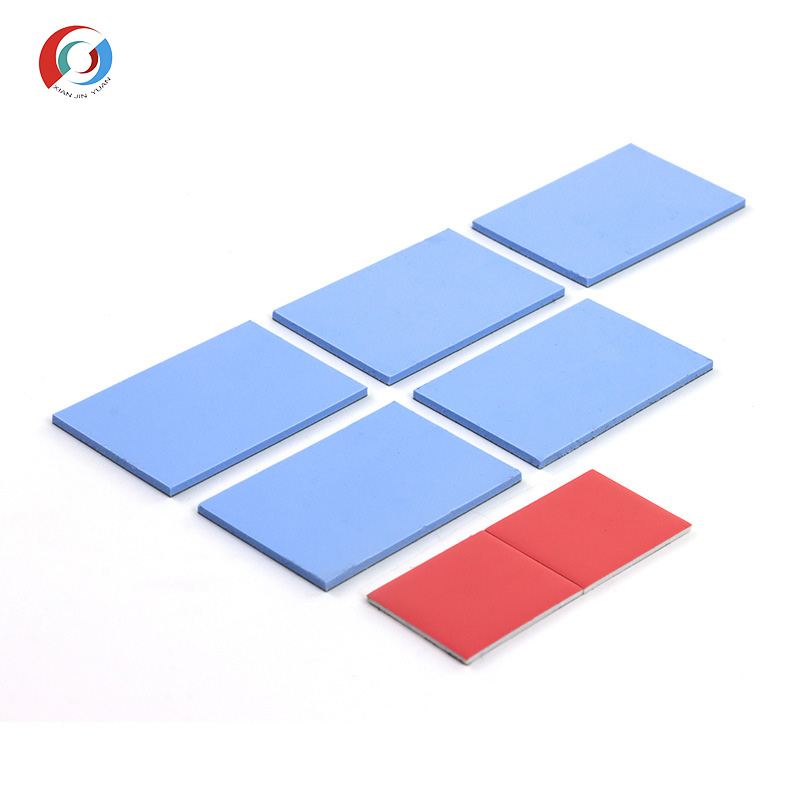
2、 Hard indicators of non silicon thermal conductive sheets: data speaks for itself
Non silicon thermal conductive sheets are not simply "without silicon". It needs to comprehensively benchmark or even surpass traditional silicon-based products in terms of thermal conductivity, mechanical performance, and reliability.
Thermal conductivity is the core indicator for measuring the thermal conductivity of a thermal conductive sheet. The thermal conductivity of mainstream non silicon thermal conductive sheets ranges from 3W/m · K to over 10W/m · K. Some high-end products have exceeded 16W/m · K, which is sufficient to meet the heat dissipation needs of high-power devices such as AI chips and optical modules DSP.
Volatile control is the "trump card" of non silicon systems. The CVCM (volatile condensable matter collected) of high-quality non silicon thermal conductive sheets can be as low as 0.004% -0.026% - which means that there will be almost no condensable matter contaminating surrounding devices during long-term high-temperature operation. This is the fundamental reason why optical modules, optical systems, satellite technology, and medical equipment choose non silicon solutions.
Long term reliability can also withstand the test. Non silicon thermal conductive sheets operate continuously at a high temperature of 125 ℃ without any performance degradation or concerns about siloxane volatilization. Realize true 'zero oil separation' during long-term operation, ensuring absolute safety of equipment metal contacts and optical end faces.
3、 Three major battlefields: core application scenarios of non silicon thermal conductive sheets
Optical communication and optical modules are the most technically rigid application areas for non silicon thermal conductive sheets. In the 800G/1.6T optical module, the laser, DSP chip, and lens components are compressed in a very small space. On the one hand, the power consumption of modules continues to rise, and the requirements for thermal conductivity efficiency are becoming increasingly high; On the other hand, the cleanliness of the lens surface directly determines the quality of the optical path - any silicone contamination can lead to a surge in error rates. Relying on self-developed silicone free system and extremely low thermal resistance technology, non silicon thermal conductive sheets are becoming the standard configuration for 800G/1.6T optical communication. Tflex from Laird ™ SF10 non silicon thermal conductive gap filling material has been evaluated by the industry as the "gold standard" for optical and data center applications.
AI data centers and servers are one of the areas with the highest demand for non silicon thermal conductive sheets. The GPU/CPU power consumption of AI servers continues to rise, and board level hardware needs to maintain core temperature stability under full load computing. Non silicon thermal conductive sheets are widely used in AI data centers, switches, routers, servers, storage devices, and other scenarios. More importantly, optical components such as optical interconnect modules and optical transceivers within data centers have extremely high requirements for environmental cleanliness - non silicon solutions simultaneously meet the dual constraints of high thermal conductivity and high cleanliness.
Medical electronics and high-end industrial control represent the ultimate requirement for reliability of non silicon thermal conductive sheets. In medical imaging equipment, precision sensors, implantable devices, and other scenarios, any trace of silicon contamination may affect diagnostic accuracy or patient safety. Non silicon thermal conductive sheets have been widely used in special fields such as medical electronics. In semiconductor manufacturing equipment and aerospace electronics, non silicon solutions have also become the preferred choice for "zero silicon pollution" requirements.
4、 Selection points: How to choose the right non silicon thermal conductive sheet for your device?
When engineers select non silicon thermal conductive sheets, it is recommended to start from the following dimensions:
Matching of thermal conductivity and thermal resistance. Devices with different power densities have varying requirements for thermal conductivity. It is recommended to choose DSP chips with a power output of 5W/m · K or higher for optical modules; It is recommended that the GPU/CPU of AI servers be above 8W/m · K.
Hardness and compressibility. The hardness of non silicon substrates is usually slightly higher than that of silicone rubber, and it is necessary to evaluate whether the installation pressure is sufficient to fully adhere the material to the contact surface. High compression ratio and low stress design are important considerations when selecting.
Volatile compounds and cleanliness level. For optical devices, CVCM value is the core indicator. The lower the CVCM, the lower the risk of contamination to the optical system.
Environmental tolerance. It is necessary to evaluate the working temperature range, flame retardant rating (such as UL94 V-0), and long-term reliability requirements.
Advanced Institute Technology provides full process technical support from material selection, sample trial production to batch delivery, helping customers incorporate non silicon thermal conductivity solutions into system considerations in the early stages of thermal design.
The global market for silicon free thermal interface materials has reached a sales volume of 1.065 billion US dollars in 2025, and is expected to grow to 1.823 billion US dollars by 2032. The sales revenue of China's silicon free thermal interface material market has reached 7.244 billion yuan in 2025, and is expected to grow to 12.39 billion yuan in 2032. Driven by the expansion of AI computing power, the improvement of optical communication bandwidth, the precision of medical electronics, and the intelligence of automotive electronics, non silicon thermal conductive sheets are moving from "professional material selection" to standard configuration for high reliability electronic device thermal management.
Advanced Institute (Shenzhen) Technology Co., Ltd. will continue to delve into the field of non silicon thermal conductive materials, providing customers with higher thermal conductivity, lower volatility, and more reliable interface thermal management solutions through constantly iterating material formulas and manufacturing processes.
 en
en  Español
 Français
 Português