1、 The 'card reading curse' on metal surfaces: why RFID tags are afraid of metal
RFID and NFC systems rely on magnetic coupling between coils to transmit energy and data. But when the label is attached to a metal surface, three things happen.
Eddy current loss is the first blow. The alternating magnetic field induces eddy currents on the metal surface, which generate a reverse magnetic field to counteract the original magnetic field, and the RF energy is wasted. The dissonance effect is the second blow. Metal is equivalent to a parallel connection of a "parasitic capacitor" and a "parasitic inductor" next to the tag antenna, causing the resonant frequency of the antenna to shift. Reflection interference is the third blow. The reflection of electromagnetic waves on metal surfaces superimposes with incident waves to form standing waves, further deteriorating coupling efficiency.
The result of triple strike superposition: A UHF tag with a reading distance of 10 meters in the air may drop sharply to less than 1 meter after being attached to a metal surface. This is the 'metal curse' that the RFID industry has been facing for decades.
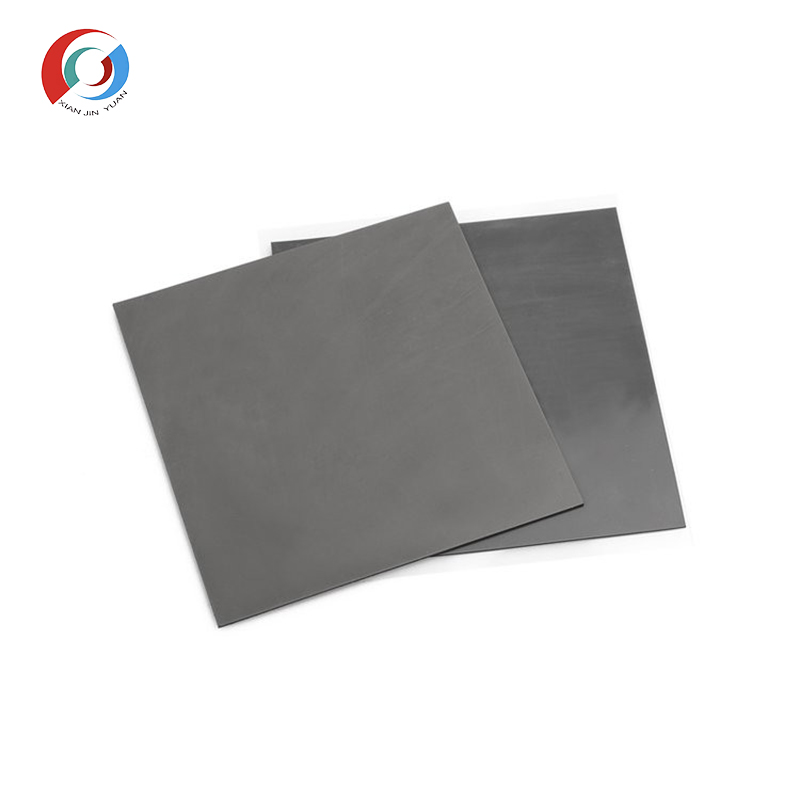
2、 Why do magnetic separators "break the curse" - a paradigm shift from reflection to guidance
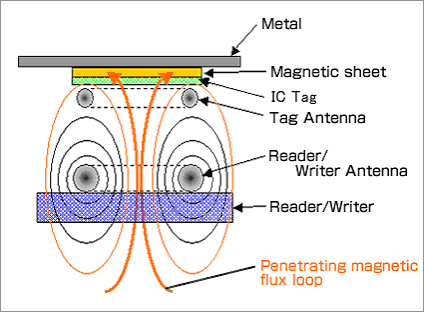
The working principle of RFID magnetic separators can be summarized in eight words: low magnetic resistance path, magnetic flux manager.
Magnetic separators are made of high permeability magnetic materials such as ferrite or nanocrystalline alloys, with a permeability typically between 120-250. When it is placed between the coil and the metal surface, due to the magnetic permeability of the magnetic material being much higher than that of air (μ r ≈ 1) and metal, magnetic lines will preferentially pass through the magnetic separator, forming a closed loop inside the separator.
The magnetic separator has built a "highway" for magnetic field lines - magnetic field lines no longer penetrate into the metal layer, there is no longer any movement of cutting magnetic induction lines in the metal, and eddy currents are effectively suppressed. At the same time, the magnetic separator constrains the magnetic field energy near the antenna, enhancing the magnetic induction strength on the tag side. Experimental data shows that a 0.5mm thick ferrite magnetic separator can increase the antenna Q value from 3.2 when attached to metal to 18.7 in the 13.56MHz frequency band.
Simply put, without a magnetic separator, the magnetic field lines "get lost" into the metal; With the magnetic separator, magnetic field lines are guided along the "right path" to complete transmission.
3、 Ferrite vs nanocrystals: material evolution of magnetic separators
The material selection of RFID magnetic separators directly determines the performance boundary. The current industry mainly adopts two technological routes.
Ferrite magnetic separators are the most widely used solution. Ferrite is an insulating magnetic material with extremely low eddy current losses and stable performance in the high frequency range of 13.56MHz. By 2025, the global production of flexible ferrite sheets with anti metal backing will reach 3.67 million square meters. Typical thickness of 0.1-0.5mm, magnetic permeability of 120-250. The advantages of ferrite are maturity and controllable cost, but it is hard, brittle, and difficult to achieve ultra-thin.
Nanocrystalline magnetic separators are a rapidly emerging new route. Nanocrystalline materials have higher magnetic permeability and lower losses, and are gradually replacing traditional ferrite magnets as important functional materials in the field of NFC/RFID. The advantages of nanocrystals are higher magnetic permeability, thickness as low as 0.05mm or less, and better flexibility. By 2025, the global market sales of NFC/RFID magnetic shielding sheets have reached 320 million US dollars, with a production volume of 5.47 million square meters. Nanocrystals are accelerating their penetration in high-performance RFID magnetic isolation scenarios due to their three major advantages of high magnetic permeability, thinning, and good flexibility.
Advanced Institute Technology can flexibly choose ferrite or nanocrystalline systems based on customer requirements for operating frequency bands (125kHz, 13.56MHz, 860-960MHz, etc.), thickness, and cost budget, providing a full range of RFID magnetic isolation products from commercial grade to high-performance grade.
4、 Data speaks for itself: What can RFID magnetic separators change?
The performance of RFID magnetic separators ultimately needs to be answered with data.
Magnetic permeability is the core indicator for measuring the ability to guide magnetic field lines. At a working frequency of 13.56MHz, the magnetic permeability range of high-performance magnetic separators can reach 120-250. High magnetic permeability means achieving more efficient magnetic flux guidance at thinner thicknesses.
The thickness determines whether the magnetic separator can be embedded in a limited space. The mainstream product thickness ranges from 0.05mm to 0.5mm. 0.3mm is already the balance point between cost and performance. Ultra thin products can be as low as 0.05mm.
The increase in Q value is a direct reflection of the magnetic isolation effect. The measured waveform shows that a thickness of 0.5mm can increase the Q value from 3.2 during metal adhesion to 18.7 in the 13.56MHz frequency band. The higher the Q value, the better the tag resonance efficiency and the farther the reading distance.
Reading distance recovery is the ultimate application effect. In RFID devices, electronic tags need to be integrated or attached to products. Due to limited space, when electronic tags are attached to the surface of conductive objects such as metals or in areas with metal components nearby, the reading distance can be restored to more than 80% of the level of free space after using magnetic separators.
5、 Three major application battlefields: from NFC payment to industrial asset management
NFC payment and smartphones are the areas with the highest usage of RFID magnetic separators. In handheld devices such as NFC payment phones, the antenna is tightly attached to the metal back panel or battery. The magnetic isolation sheet is attached between the antenna and the metal backplate to eliminate metal interference, increase communication sensitivity, and improve recognition accuracy and stability. The global market sales of NFC/RFID magnetic shielding sheets have reached 320 million US dollars by 2025.
Anti metal tags and asset management represent the most essential application direction for RFID magnetic separators. In the metal integrated installation environment, absorbing materials solve the technical problem that electronic tags cannot be attached to metal surfaces. Magnetic separators can be used for tags on different chips such as 125kHz and 13.56MHz, and packaged and processed into anti metal and anti electromagnetic interference tags. In scenarios such as industrial asset management, logistics warehousing, and metal shelf identification, RFID magnetic separators are key enabling materials for achieving "labeling on metal".
Access control card reading and intelligent terminals are application areas where RFID magnetic separators are rapidly penetrating. In devices such as access control card readers, anti-counterfeiting card readers, and water, electricity, and gas meter card readers, the card reading antenna is located adjacent to the metal casing or circuit board. The magnetic separator is embedded inside the card reader to isolate the circuit board from the magnetic induction field. In scenarios such as POS machines, smart door locks, and identity recognition terminals, magnetic separators are also key components to ensure stable card reading.
6、 Selection points: How to choose the right magnetic separator for your RFID device?
When engineers select RFID magnetic separators, it is recommended to start from the following dimensions:
The working frequency is the first matching term. 125kHz low frequency, 13.56MHz high frequency (HF), and 860-960MHz ultra-high frequency (UHF) have different electromagnetic parameter requirements for magnetic separators. 13.56MHz is the standard frequency for NFC and most RFID applications.
Magnetic permeability and thickness need to be considered comprehensively. Under the same magnetic permeability, the thicker the thickness, the better the magnetic isolation effect; But an increase in thickness means an increase in space occupation. 0.3mm is the balance point for most applications. The ultra-thin scene can choose the 0.05-0.1mm scheme.
The material system determines the upper limit of performance. Mature and reliable ferrite with controllable cost; Nanocrystals have higher magnetic permeability, thinner thickness, and better flexibility. It is recommended to prioritize the nanocrystalline solution for high-performance scenarios.
Environmental tolerance is crucial for long-term reliability. Need to evaluate the working temperature range, flame retardant rating, and whether vehicle grade certification is required. The Curie temperature needs to be higher than 85 ℃ to adapt to long-term operation.
Advanced Institute Technology provides full process technical support from material selection, sample trial production to batch delivery, helping customers incorporate RFID magnetic isolation solutions into their system considerations in the early stages of product design.
The global market sales of flexible ferrite sheets with anti metal backing will reach 165 million US dollars in 2025, and it is expected to reach 292 million US dollars in 2032. The global market for NFC/RFID magnetic shielding sheets is expected to reach $495 million by 2032. Driven by the popularization of NFC payments, the expansion of industrial IoT, the penetration of intelligent access control, and the digitization of asset management, RFID magnetic separators are moving from "professional material selection" to standard configurations for RFID and near-field communication system design.
Advanced Institute (Shenzhen) Technology Co., Ltd. will continue to deepen its cultivation in the field of RFID magnetic separators, providing customers with higher performance and more reliable magnetic flux guidance and signal enhancement solutions through material innovation and precision technology.

 en
en  Español
 Français
 Português