1、 What does 2.3 μ m mean? ——What challenges does the aluminum plating process face when the substrate approaches its physical limit
The thickness of PET film is continuously evolving from the conventional 12 μ m and 25 μ m to thinner scales. The PET substrate with a thickness of 2.3 μ m is one order of magnitude thinner than the mainstream in the industry.
On the roll to roll continuous coating production line, 2.3 μ m PET is a "dangerous" presence - it can break under slightly high tension, shrink at slightly high temperatures, and wrinkle at slightly faster speeds. The vacuum aluminum plating process for conventional thickness PET is quite mature, but the challenge of compressing the substrate thickness to 2.3 μ m is no longer whether it can be plated, but whether it can still be used after plating.
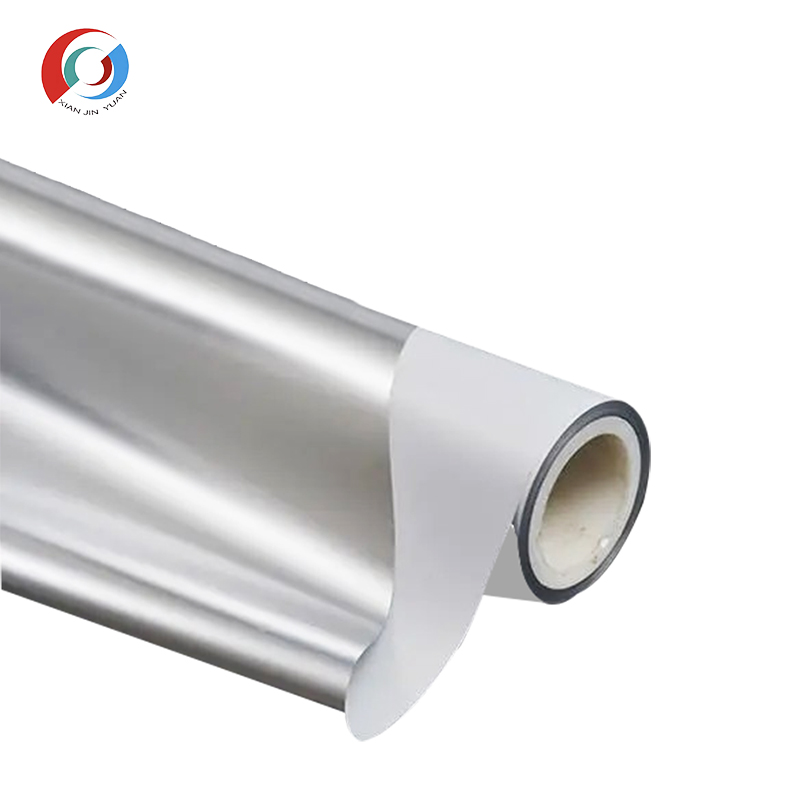
Advanced Institute Technology uses vacuum evaporation technology to heat high-purity aluminum to the evaporation temperature in a highly vacuum environment, allowing aluminum vapor to uniformly deposit on the surface of PET film, forming a layer of metallization. The thickness of the aluminum layer is usually adjustable within the range of 20-100 nanometers. The presence of aluminum layer reduces the permeability of PET film to oxygen and water vapor by more than 99%, while the reflectivity can reach over 90%. In response to the special challenges of the 2.3 μ m ultra-thin substrate, the company has achieved precise control in tension control, temperature control accuracy, and coating uniformity, ensuring that every meter of product can withstand inspection.
2、 Data Speaking: 0.3 μ m Aluminum Layer, 225m Ω Square Resistance - The "Optimal Solution" for Conductivity Performance
In the advanced technology 2.3 μ m PET aluminum plated film product series, the 2.3 0.3PET aluminum plated film is undoubtedly the main promoted model - with an aluminum layer thickness of 0.3 μ m and a measured square resistance as low as 225m Ω, it is the most conductive among the three models.
The relationship between aluminum layer thickness and square resistance is not simply a linear decrease. The measured square resistance of 2.3 0.7PET aluminum plated film (aluminum layer 0.7 μ m) is 380m Ω, which is higher than the 225m Ω of the 0.3 μ m model. This is not abnormal, but the result of the combined effect of aluminum layer grain structure and deposition process - an excessively thick aluminum layer may cause grain coarsening on ultra-thin substrates due to stress accumulation, which in turn affects the efficiency of conductive pathways. 0.3 μ m precisely finds the "sweet spot" of performance: it ensures the continuity and density of the aluminum layer, while avoiding stress problems caused by excessive thickness. Research has shown that Al electrodes deposited on the surface of PET films have high square resistance and better current carrying capacity.
The value of a 0.3 μ m aluminum layer goes beyond conductivity. On a 2.3 μ m ultra-thin substrate, increasing the thickness of the aluminum layer by 0.1 μ m will affect the flexibility and bending life of the material. 0.3 μ m achieves the optimal balance between conductivity and flexibility - providing sufficiently low resistance to meet circuit transmission requirements while maintaining the ultimate bending ability of ultra-thin substrates. The ultra-thin aluminum plated PET film (aluminum layer thickness ≤ 30 nanometers) developed by Advanced Institute Technology has been successfully applied in fields such as flexible display screens and 5G communication equipment, with no cracks after 100000 cycles when the bending radius is ≤ 1mm.
3、 Application boundary of 0.3 μ m aluminum layer: When both "thin" and "conductive" become essential
Flexible circuits and wearable devices are the most representative application scenarios for 2.3 0.3 PET aluminum plated film. Flexible electronic products require signal transmission in extremely thin spaces while withstanding repeated bending. The combination of a 2.3 μ m ultra-thin substrate and a 0.3 μ m aluminum layer significantly reduces the thickness of conductive lines, freeing up critical space for the miniaturization design of equipment. Low surface resistance (<1 Ω/□) and excellent bending durability provide material support for the miniaturization design of wearable devices.
Electromagnetic shielding and 5G communication are the fastest-growing application directions for 0.3 μ m aluminum layers. The aluminum layer can effectively shield electromagnetic interference (EMI) while maintaining durability. In 5G communication equipment and RF front-end modules, PET aluminum plated film has become an ideal electromagnetic shielding material due to its excellent conductivity and lightweight characteristics. By increasing the thickness of the aluminum layer to over 100 nanometers, the shielding effectiveness can be ensured to reach over 40dB. The 0.3 μ m aluminum layer provides reliable electromagnetic protection capability within this range.
Optical reflection and energy-saving applications also benefit from the precise thickness of the 0.3 μ m aluminum layer. The PET aluminum plated reflective film has achieved a visible light reflectivity of over 92% and an infrared blocking rate of 85%. In situations that require high reflectivity but are sensitive to weight, such as building energy-saving glass interlayers and photovoltaic backboards, a 0.3 μ m aluminum layer ensures reflective performance while minimizing weight gain. The high reflectivity of the aluminum layer can block more than 80% of infrared radiation, reducing building energy consumption.

4、 Product matrix: 0.3 μ m is the main promotion, with more options available
0.3 μ m is the main recommended model in the Advanced Institute Technology 2.3 μ m PET aluminum plated film series, but it is not the only choice. The company also offers the following customization options:
-
2.3 0.1PET aluminum plated film (aluminum layer 0.1 μ m, measured square resistance 520m Ω): extremely lightweight and suitable for scenarios with extremely high bending life requirements
-
2.3 0.7PET aluminum plated film (aluminum layer 0.7 μ m, measured square resistance 380m Ω): highly reliable and durable, suitable for scenarios requiring certain structural strength
Different thicknesses of aluminum layers correspond to different resistance properties and application scenarios. Advanced Institute Technology supports on-demand customization, accurately matching customers' differentiated needs. The company has passed ISO9001 certification and its products comply with RoHS environmental requirements.
The global market size of aluminum coated PET film has reached 11.47 billion yuan by 2025, and is expected to grow to 16.28 billion yuan by 2032. Driven by the popularization of flexible electronics, deployment of 5G communication, upgrading of building energy efficiency, and expansion of new energy applications, the 2.3 μ m ultra-thin PET aluminum plated film is moving from "extreme manufacturing" to a standard option for multifunctional substrates in multiple fields.
Advanced Institute (Shenzhen) Technology Co., Ltd. will continue to deeply cultivate the field of ultra-thin PET aluminum plated film, providing customers with higher performance and more reliable flexible substrate conductive solutions through precision coating technology and continuous technological innovation.

 en
en  Español
 Français
 Português