1、 From "Two Sets" to "One Set": The Engineering Value of Composite Extrusion Process
The core function of conductive rubber strips is to establish a continuous conductive path between two metal mating surfaces to achieve electromagnetic shielding; Simultaneously provide environmental sealing to prevent water vapor and dust from entering. However, there is a structural contradiction between the material requirements for these two functions.
The conductivity requirement is to fill a large amount of conductive particles (such as silver plated aluminum, silver plated copper, nickel plated graphite, etc.) in the silicone rubber matrix, and the higher the filling amount, the better the conductivity. But the increase of conductive fillers will significantly improve the hardness and compression permanent deformation rate of the material, weakening the sealing performance. There is a trade-off between the conductivity and sealing of a single material - the better the conductivity, the worse the sealing.
The composite extrusion process is precisely designed to break this contradiction. It simultaneously extrudes and vulcanizes conductive silicone rubber (conductive material) and non-conductive silicone rubber (environmental sealing material) through a co extrusion mold. The two parts form a chemical bond during the extrusion process, forming a whole. The conductive part is responsible for establishing a low resistance conductive path and EMI shielding; The non-conductive part maintains the original low hardness, high elasticity, and excellent compression rebound characteristics of silicone rubber, and is responsible for environmental sealing.
The design logic of "each performing its own duties, forming at once" brings multidimensional engineering value:
-
Performance aspect: The non-conductive part does not contain conductive fillers, maintaining the elasticity and sealing performance of silicone rubber, enabling the composite extruded strip to have better environmental sealing ability and longer service life under the same shielding effectiveness.
-
Cost aspect: Conductive fillers (especially silver based fillers) are the most expensive material component in conductive rubber. Composite extrusion design only uses conductive elastomers in areas that require conductivity, which can significantly reduce the amount of precious metal fillers used.
-
Installation level: One material simultaneously completes both EMI shielding and environmental sealing tasks, simplifying the assembly process and avoiding the problem of fitting tolerances between two independent sealing components.
2、 Material selection: synergy from conductive fillers to matrix rubber
The performance of composite extruded conductive rubber strips is rooted in the synergy between conductive materials and matrix materials. Engineers can flexibly choose material combinations based on the EMC requirements, environmental conditions, and cost budget of the application scenario.
Conductive fillers determine the core of EMI shielding effectiveness. Different filler systems correspond to different conductivity and shielding levels:
-
Silver plated aluminum (Ag/Al): It has excellent galvanic compatibility in aluminum chassis scenarios, with a volume resistivity as low as 0.008 Ω· cm and a shielding efficiency of 105-120dB at 2GHz frequency.
-
Silver plated copper (Ag/Cu): with the best conductivity and a volume resistivity as low as 0.002-0.004 Ω· cm, it is suitable for military and high-end communication scenarios that require extremely high shielding effectiveness.
-
Nickel plated graphite (Ni/C): With outstanding cost-effectiveness and a volume resistivity of about 0.1 Ω· cm, it is suitable for commercial communication equipment and general industrial scenarios.
-
Silver plated glass (Ag/G): Provides a compromise between performance and cost.
The matrix rubber determines the environmental sealing and weather resistance performance:
-
Silicone rubber: The working temperature ranges from -55 ℃ to 170 ℃, with good flexibility and resistance to high and low temperatures.
-
Fluorosilicone rubber: resistant to chemical media such as fuel and solvents, suitable for harsh environments such as automobiles and petrochemicals.
The advantage of the composite extrusion process is that engineers can use highly conductive fillers for conductive parts and pure silicone rubber (without conductive fillers) for non-conductive parts. The two parts are simultaneously vulcanized during co extrusion to form a whole.
3、 Performance advantage: Integration of shielding, sealing, and economy
The performance positioning of composite extruded conductive rubber strips can be summarized into three keywords: shielding, sealing, and economy.
In terms of shielding effectiveness, the composite extruded conductive rubber strip exhibits stability over a wide frequency range. The conductive part filled with silver plated aluminum or silver plated copper can achieve a shielding efficiency of 100-120dB at a frequency of 2GHz. 100dB means that 99.99999999% of electromagnetic waves are effectively blocked - enough to meet the strict EMC standards of communication equipment and military electronic equipment. The shielding performance of conductive rubber can cover a wide frequency range from low frequency to 40GHz.
In terms of environmental sealing, non-conductive silicone rubber provides excellent water vapor sealing and dust prevention capabilities. Paired with the appropriate groove size, the highest protection level can reach IP68. The non-conductive part does not contain conductive fillers, maintaining the low hardness and high elasticity of silicone rubber, and can still maintain good rebound performance after long-term compression.
In terms of cost-effectiveness, the composite extrusion design only uses conductive elastomers in areas where conductivity is required, significantly reducing the amount of precious metal fillers used. Meanwhile, replacing two sets of independent seals with one material reduces material management and assembly costs.
In terms of standard compliance, the composite extruded conductive rubber strip can meet the requirements of MIL-DTL-83528 military standard. This standard establishes a complete technical specification for conductive elastomer shielding gaskets, from material composition to performance testing. Products that have passed this certification can be included in the qualified product list of the United States Defense Logistics Agency.
4、 Three major application battlefields: from 5G base stations to military electronics
Communication equipment and data centers are one of the areas with the highest demand for composite extruded conductive rubber strips. In 5G base stations, communication cabinets, switches, routers and other equipment, chassis door frames and panel interfaces are not only the main channels for electromagnetic leakage, but also the critical paths for water vapor and dust intrusion. The composite extruded conductive rubber strip can be directly installed in the sealing groove, while completing EMI shielding and environmental sealing. Its wide temperature range working ability (-55 ℃ to 170 ℃) and IP68 protection level enable it to adapt to the harsh outdoor environment of base stations.
The military and aerospace industries represent the application fields with the highest reliability requirements for composite extruded conductive rubber strips. In military electronic cabinets, radar systems, ship electronic equipment, and aviation electronic equipment cabins, the complexity of the electromagnetic environment is much higher than that of ground equipment, and it also needs to withstand severe temperature changes, vibration impacts, and salt spray corrosion. The composite extruded conductive rubber strip can meet the MIL-DTL-83528 military standard. The conductive part ensures electromagnetic sealing, while the non-conductive silicone rubber part provides environmental sealing resistant to mold and salt spray corrosion. In harsh environments, conductive elastomer rubber can be used to achieve both environmental sealing and EMI electromagnetic shielding sealing.
Automotive electronics and industrial control are the fastest-growing application directions for composite extruded conductive rubber strips. Vehicle electronic control units (ECUs), sensors, connectors, etc. have dual requirements for electromagnetic compatibility and sealing protection. The battery management system of new energy vehicles and the sealing requirements of high-voltage wiring harnesses are becoming important driving forces for the growth of demand for composite extruded conductive rubber strips. In scenarios such as industrial control cabinets and medical equipment that require both EMI shielding and high protection levels, composite extruded conductive rubber strips also play a critical role.
5、 Selection points: How to choose composite extruded conductive rubber strips for your equipment?
When engineers select composite extruded conductive rubber strips, it is recommended to start from the following dimensions:
The selection of conductive fillers determines the upper limit of shielding effectiveness. It is recommended to choose silver plated copper or silver plated aluminum system for military and high-end communication scenarios (shielding effectiveness> 100dB@2GHz ); Commercial equipment and general industrial scenarios can choose nickel plated graphite or silver plated glass systems (with outstanding cost-effectiveness).
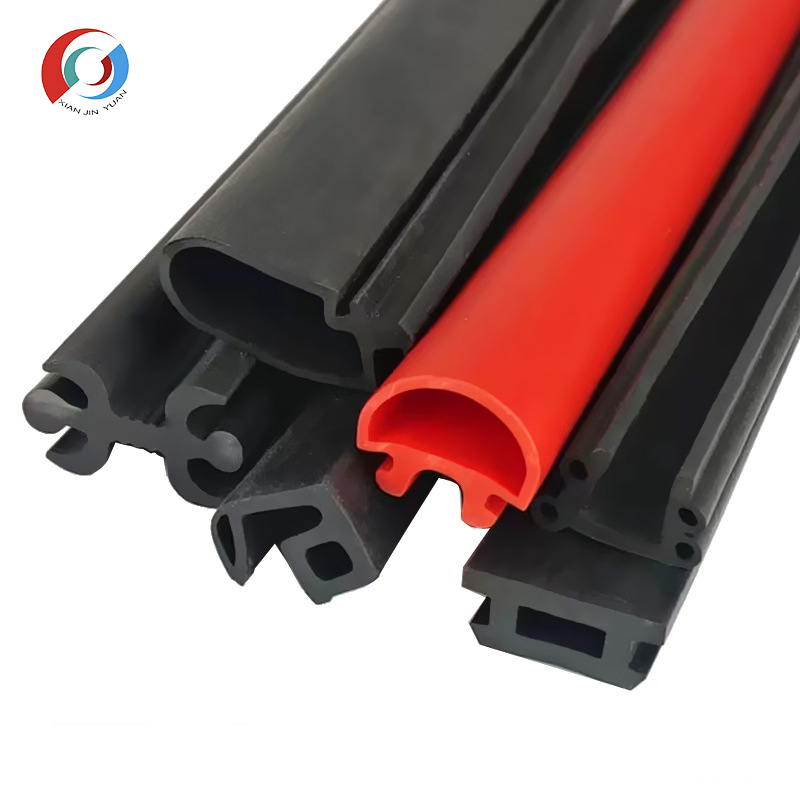
The customization of cross-sectional shape determines the installation adaptability. The composite extrusion process supports flexible customization from simple rectangles, D-shapes to complex irregular cross-sections. Conductive parts can be placed at the top, bottom, or sides, while non-conductive parts fill the remaining areas - this "on-demand arrangement" design freedom allows engineers to accurately match different flange shapes and sealing requirements.
The setting of compression is related to the balance between shielding and sealing. The recommended compression amount for composite extruded conductive rubber strips depends on the cross-sectional design and hardness level. Overvoltage may cause the conductive path to be squeezed and accelerate permanent deformation, while undervoltage may affect shielding and sealing effectiveness.
Environmental tolerance determines long-term lifespan. It is necessary to evaluate the working temperature range (silicone rubber substrate -55 ℃ to 170 ℃, fluorosilicone rubber can withstand fuel and solvents), chemical medium contact, salt spray corrosion risk, and protection level requirements (up to IP68).
Advanced Institute Technology provides full process technical support from cross-sectional design, material selection, sample trial production, and batch delivery.
The global EMI shielding gasket market is in a sustained growth channel. Driven by the deployment of 5G/6G communication, military electronic upgrades, and the deep evolution of automotive electrification and intelligence, composite extruded conductive rubber strips with dual functions of EMI shielding and environmental sealing are moving from "professional material selection" to standard configurations for electromagnetic compatibility and sealing design of electronic devices.
Advanced Institute (Shenzhen) Technology Co., Ltd. will continue to delve into the field of co extrusion molding of conductive elastomers, providing customers with higher performance and more reliable integrated solutions for conductive sealing through material innovation and precision processes.

 en
en  Español
 Français
 Português