1、 Rigid vs Flexible: The Core Contradiction of Brain Computer Interface Electrodes
Brain computer interface electrodes can be divided into three categories: non-invasive (scalp EEG), semi invasive (cortical EEG), and invasive (cortical microelectrode). Among them, invasive electrodes can achieve the highest signal accuracy and richest functions by directly "talking" with neurons. But behind this advantage lies a long-standing engineering challenge - the mechanical mismatch between electrodes and brain tissue.
Traditional invasive electrodes are mainly made of silicon-based materials, with representative products including Utah Array (100 channels, 10 × 10 grid, 400 μ m spacing) and Michigan probe. The Young's modulus of silicon exceeds 50 GPa, while that of brain tissue is only about 1-10 kPa. When hard electrodes are implanted into the soft, slightly pulsating brain that follows the heartbeat and breathing, the relative movement between the two continues to wear down surrounding tissues, causing glial scar wrapping and neuronal death. The signal-to-noise ratio of the Utah array is about 6:1, and on average, each electrode can record 3.4 neurons - but this number will continue to decrease over long-term implantation.
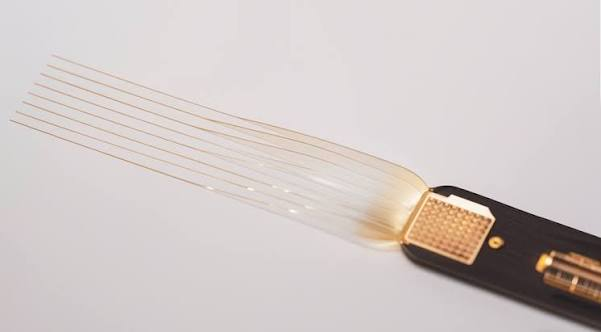
Flexible electrodes are designed to address this contradiction. By changing the electrode material from rigid silicon base to flexible polymer (polyimide, poly (p-xylene C), PDMS, hydrogel, etc.), the mechanical properties of the electrode are closer to the brain tissue, thus greatly improving the mechanical compatibility.
2、 Material System: From Precious Metals to Conductive Polymers
The performance of brain computer interface electrodes is rooted in the synergy between conductor materials and substrate materials.
In terms of conductor materials, gold (Au), platinum (Pt), iridium (Ir), and their alloys (such as PtIr) are the most widely used metals in neural implants. Gold fittings have good biocompatibility and conductivity, and platinum black is widely used in neural electrodes due to its high specific surface area and low impedance. The electrode sites modified with iridium oxide (IrOx) can reduce impedance by nearly two orders of magnitude relative to bare gold. Although traditional metals have excellent conductivity, their rigidity can easily cause tissue damage.
Conductive polymers have been a research hotspot in recent years. PEDOT: PSS is widely used for surface modification of flexible neural electrodes due to its good biocompatibility, excellent conductivity, and ease of synthesis. The most advanced flexible neural electrode designs such as NeuroGrid and Neuralink use PEDOT: PSS as the standard electrode coating. Conductive polymer coatings can also improve the integration effect of implants by reducing the Young's modulus. High performance composite materials such as gold coated titanium dioxide nanowires also provide new possibilities for improving electrode performance.
The selection of matrix material is equally crucial. Young's modulus of flexible substrates such as polyimide, poly (p-xylene C), PDMS and hydrogel is closer to that of brain tissue. The e-dura electrode uses a 120 μ m thick silicone substrate, integrated with microcrack gold interconnects and a 300 μ m platinum silicone electrode, with an impedance of approximately 5.2k Ω, and can withstand millions of tensile cycles at 20% strain. The NeuroWeb probe uses stacked hexagonal boron nitride (h-BN) and graphene layers with a total thickness of approximately 40nm, an optical transparency of 97.2%, and a signal amplitude of approximately 122 μ V.
3、 Performance indicators: impedance, number of channels, and long-term stability
The performance of brain computer interface electrodes ultimately needs to be answered by three core indicators.
Impedance determines the signal-to-noise ratio of signal acquisition. The lower the impedance, the higher the efficiency and clarity of neural signal acquisition. The electrode impedance of the Utah array is typically in the order of several hundred k Ω, while flexible electrodes can reduce impedance to lower levels through surface modification. The signal amplitude of the NeuroWeb probe is approximately 122 μ V. Iridium oxide modification can reduce impedance by nearly two orders of magnitude relative to bare gold.
The number of channels determines the flux of information collection. The Utah array has 100 channels. NeuroWorm integrates 60 independent channels. The first multi center clinical trial of a 128 channel fully implantable brain computer interface system in China, launched in May 2026, marks another leap in the number of channels. The 9 μ m fully organic ultra flexible electrode array developed by the Tsinghua University team has a channel density of up to 853 channels/cm ².
Long term stability is the core differentiating advantage of flexible electrodes compared to rigid electrodes. NeuroWorm has been working stably in the leg muscles of rats for over 43 weeks. After 13 months of implantation, the average thickness of the fibrous coating is less than 23 μ m, and the cell apoptosis rate is comparable to that of normal tissue. The fully organic ultra flexible electrode from Tsinghua University achieved stable neural recording for up to 550 days in New Zealand rabbits. The research results of NeuroWorm were published in the journal Nature in September 2025.
4、 Frontier breakthrough: paradigm shift from "static" to "dynamic"
In September 2025, Shenzhen Advanced Technology Research Institute of the Chinese Academy of Sciences and Donghua University team published a breakthrough achievement NeuroWorm in Nature. This is the first new paradigm of brain computer interface "dynamic electrode" proposed internationally.
Traditional implantable electrodes are all "static" - after implantation, they can only be fixed in position, limited in collection, and cannot make responsive adjustments to the surrounding environment. NeuroWorm is a soft and stretchable fiber electrode with a diameter of only 196 microns, and 60 independent channels for collecting bioelectric signals are distributed along the length of the fiber. The research team embedded a tiny magnetic control unit in the fiber head, combined with a high-precision magnetic control system and real-time image tracking technology, allowing the electrode to autonomously regulate its direction of advancement in the body. Under magnetic field control, NeuroWorm achieved "roaming" within the rabbit's skull and actively changed monitoring targets as needed.
The significance of this breakthrough lies in the upgrade of electrodes from passive "fixed sensors" to active "movable detectors" - capable of switching monitoring targets between different regions of the brain and long-term stable operation in peripheral tissues such as muscles. It marks a fundamental shift in bioelectronic interfaces from static operation to dynamic operation, from passive recording to active response.
5、 From Laboratory to Clinical: Industrialization Process of Brain Computer Interface Electrodes
On May 18, 2026, China's first multi center clinical trial of a 128 channel fully implantable brain computer interface system was officially launched, using cortical implantable flexible linear electrodes. The research team led by Fang Ying from the Beijing Institute of Neuroscience and Brain like Research has proposed an original high-throughput stretchable flexible electrode architecture. Through strain decoupling, the tensile load is converted into bending and twisting deformation, allowing the electrode to dynamically follow the brain's pulsation and intracranial displacement after implantation. The wireless invasive brain computer interface system equipped with this new electrode is about to enter the clinical trial stage.
By 2025, the global market size of high-density electrode arrays for implantable brain computer interfaces will reach approximately 1.28 billion US dollars, an increase of over 470% compared to 2020, with medical rehabilitation applications contributing 71.3% of the market share. The global market size of medical flexible bioelectrodes is approximately 245 million US dollars, and it is expected to approach 728 million US dollars by 2032. The shipment volume of flexible film electrodes and microneedle array electrodes increased by 89% and 127% year-on-year, respectively.
6、 Advanced Institute's Capability: Accumulation of Flexible Substrate and Precision Metalization Technology
The core capabilities that Advanced Institute (Shenzhen) Technology Co., Ltd. can provide in the field of brain computer interface electrodes are rooted in two major technological pillars.
Precision machining of flexible substrates is the foundation of electrode manufacturing. The company has the ability to perform high-precision micro nano processing on various flexible films such as PI, Parylene, PDMS, PET, PEN, etc., and supports customized electrode pattern design and multi-layer structure stacking processes. In response to the special requirements for ultra-thin and high flexibility of brain computer interface electrodes, the company can provide customized solutions with substrate thicknesses as low as a few micrometers.
Flexible substrate metallization coating is the key to achieving electrode functionality. The company's mature roll to roll magnetron sputtering and vacuum evaporation processes support precise deposition of biocompatible metal conductive layers such as gold, platinum, iridium, titanium, etc. on flexible substrates. The thickness and uniformity of the coating can be accurately controlled. By combining surface modification techniques with conductive polymers such as PEDOT: PSS, the impedance and charge injection capability of the electrode can be further optimized.
7、 Outlook
The global brain computer interface market is in a high-speed growth channel. The global non-invasive brain computer interface market is estimated to reach $4.87 billion by 2025 and is expected to reach $31.25 billion by 2030. As a revolutionary technology in the field of neural engineering, flexible electrode technology is achieving high fidelity acquisition and long-term stable transmission of neurophysiological signals through excellent biocompatibility.
The technological evolution of brain computer interface electrodes is accelerating, from rigid silicon-based to flexible polymers, from static fixation to dynamic controllability, from laboratory research to multi center clinical trials. Advanced Institute (Shenzhen) Technology Co., Ltd. will continue to deepen its expertise in precision processing of flexible substrates and metal coating, providing key materials and process support for the industrialization of brain computer interface electrodes.

 en
en  Español
 Français
 Português