1、 What does 4 μ m mean? ——The engineering value of ultra-thin substrates
The thickness of PET film decreases from the conventional 25 μ m and 12 μ m to 4.5 μ m and 4 μ m - each thickness crossing redefines the physical boundaries of flexible electronic design.
The 4 μ m PET substrate poses multiple challenges in tension control, temperature control accuracy, and coating uniformity in roll to roll continuous coating production. In the vacuum evaporation process, the substrate needs to have good heat resistance. Excessive temperature can cause deformation of the substrate, uneven thickness or cracking on the surface. The ultra-thin specification of 4 μ m further amplifies the flexibility advantage of PET - smaller bending radius, lower bending stress, and lighter weight per unit area.
In the hinge cable of foldable screen phones, for every 1 μ m reduction in substrate thickness, the design space of the hinge mechanism can be released one more minute; In the micro sensors of wearable devices, the thinner the substrate, the higher the comfort of wearing the device. The thickness of 4 μ m approaching the physical limit is precisely in response to these engineering requirements of "space as performance".
Advanced Institute Technology adopts vacuum evaporation technology to heat high-purity aluminum to the evaporation temperature in a highly vacuum environment, allowing aluminum vapor to uniformly deposit on the surface of PET film. The thickness of the aluminum layer can be processed accurately according to customer requirements. By using roll to roll continuous coating technology, the flatness and coating uniformity of ultra-thin substrates during high-speed operation are ensured.

2、 Product Matrix from Square Resistance Data: Three Aluminum Layer Thicknesses, Three Performance Positions
Conductivity is the core functional indicator of PET aluminum plated film, and sheet resistance is the most direct parameter for measuring conductivity performance. The lower the square resistance, the smaller the signal transmission loss and the higher the conductivity efficiency under the same conditions.
Advanced Institute Technology's 4 μ m PET aluminum plated film series offers three aluminum layer thickness options, covering the complete performance range from high-frequency bending to high conductivity:
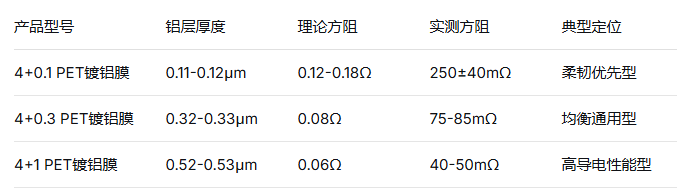
There is a clear negative correlation between the thickness of the aluminum layer and the square resistance - the thicker the aluminum layer, the lower the square resistance. The measured square resistance of the 0.11-0.12 μ m aluminum layer is 250 ± 40m Ω. The resistance of the 0.32-0.33 μ m aluminum layer decreases to 75-85m Ω, and the resistance of the 0.52-0.53 μ m aluminum layer further decreases to 40-50m Ω. This data trend clearly reflects the physical law that the conductivity improves with the increase of aluminum layer thickness.
Among the three models, the 4 1PET aluminum plated film achieved a measured square resistance of 40-50m Ω with an aluminum layer of 0.52-0.53 μ m, making it the most conductive model in the series and suitable for scenarios with strict requirements for low resistance. The 4 0.3PET aluminum plated film achieved a good balance between conductivity and flexibility with a measured resistance of 75-85m Ω. At the cost of a square resistance of 250 ± 40m Ω, the 0.1PET aluminum plated film achieved minimal impact on the flexibility of the substrate.
3、 From 40m Ω to 250m Ω: Different square resistances correspond to different scenarios
4 1PET aluminum plated film (40-50m Ω) - high conductivity type
The aluminum layer with a thickness of 0.52-0.53 μ m and a measured square resistance as low as 40-50m Ω is the "ceiling" of the conductivity performance of this series. Ultra low impedance means extremely low signal transmission loss and stronger current carrying capacity. In electromagnetic shielding scenarios that require high conductivity, low impedance directly corresponds to higher shielding effectiveness. When the thickness of the aluminum plating layer reaches 0.52-0.53 μ m, the aluminum layer has a higher density and a more complete conductive path. Suitable for scenarios with high conductivity requirements - high-frequency signal transmission lines, high-performance electromagnetic shielding layers, and flexible circuits with strict resistance requirements.
4 0.3PET aluminum plated film (75-85m Ω) - balanced universal type
The aluminum layer with a thickness of 0.32-0.33 μ m and a measured square resistance of 75-85m Ω have found a balance between conductivity and flexibility. The aluminum layer thickness of 0.32-0.33 μ m ensures sufficient conductive path density without significantly affecting the bending performance of the substrate due to excessive thickness. The Al electrode deposited on the surface of PET film not only has high square resistance, but also has better flow capacity. The square resistance of 75-85m Ω is sufficient to meet the conductivity requirements of the vast majority of flexible circuits and electromagnetic shielding scenarios, making it the most widely applicable model in this series - flexible circuit boards, electromagnetic shielding films, and conductive lines for wearable devices.
4 0.1PET aluminum plated film (250 ± 40m Ω) - flexible priority type
0.11-0.12 μ m aluminum layer, measured square resistance of 250 ± 40m Ω. The aluminum layer is the thinnest and has the least impact on the flexibility of the substrate. In scenarios that require extremely small bending radii and high-frequency bending, ultra-thin aluminum layers mean lower bending stresses and longer fatigue life. The 0.11-0.12 μ m aluminum layer is designed to maximize the bending life advantage - folding screen hinge cables, flexible sensors, and dynamic flexible circuits that require repeated bending.
4、 Process guarantee: Vacuum evaporation and roll to roll continuous coating
Advanced Institute Technology produces 4 μ m PET aluminum plated film using vacuum evaporation technology. Melting and evaporating high-purity aluminum wire into gaseous aluminum at a temperature of 1200 ℃ -1400 ℃ in a high vacuum environment, gaseous aluminum molecules are uniformly deposited on the surface of PET film, forming a continuous and dense aluminum layer. The vacuum degree of the coating chamber needs to be maintained between 10 ⁻ ² and 10 ⁻⁵ Pa to ensure that aluminum vapor molecules can reach the substrate surface without collision.
In response to the special challenges of 4 μ m ultra-thin substrates, the company has achieved precise tension control and temperature control management on the roll to roll continuous coating production line. Modern production lines adopt computer control systems to ensure the stability of process parameters and consistency of products. The adhesion and uniformity of the aluminum layer can withstand strict inspection.
Advanced Institute Technology supports customized aluminum layer thickness and substrate specifications as needed. Whether it requires ultra-thin design to meet the strict requirements of space and weight for precision electronic devices, or thicker design to enhance conductivity, precise matching can be achieved.
5、 Selection suggestion: How to choose the most suitable model for your application?
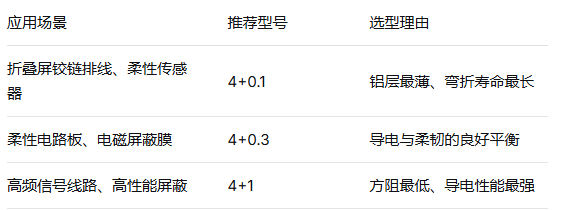
When selecting, it is necessary to comprehensively evaluate factors such as the working temperature range (PET substrate heat resistance of about 120 ℃), bending frequency and radius, environmental corrosion risk (salt spray, humidity), etc. Advanced Institute Technology provides full process technical support from sample trial production to batch delivery.
The global sales of aluminum coated PET film market reached 10.8-11.47 billion yuan in 2025, and it is expected to reach 15.61-16.28 billion yuan in 2032. Driven by the popularization of flexible electronics, the explosion of wearable devices, and the continuous growth in demand for electromagnetic shielding, the 4 μ m ultra-thin PET aluminum plated film is providing engineers with precise matching of conductive substrates for different scenarios, with a complete coverage range from 40-50m Ω to 250 ± 40m Ω.

 en
en  Español
 Français
 Português