1、 Why is phase change material smarter than silicone grease for solid-state installation and liquid service?
Thermal conductive silicone grease was once the "standard answer" for chip heat dissipation. But it has a fatal weakness: in repeated high and low temperature cycles, the silicone grease will gradually be "pumped out" of the contact surface - dry, cracked, and ineffective.
The working mode of phase change materials is completely different.
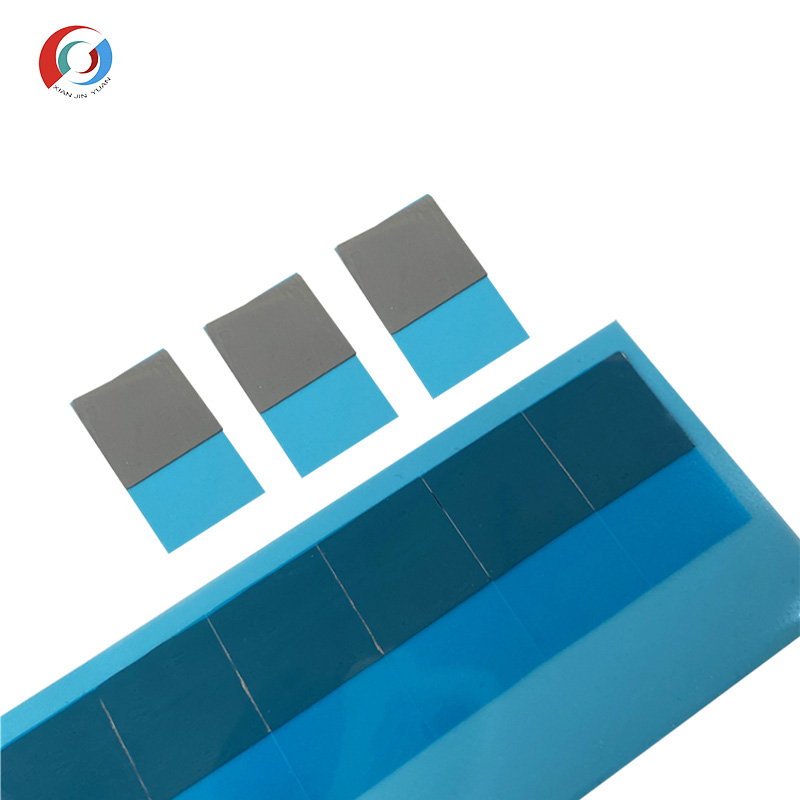
At room temperature, it is a solid sheet material that is easy to install like a thermal pad, does not flow, and does not contaminate surrounding devices. Once the chip starts working and the temperature rises to the phase transition point (usually between 45 ℃ -60 ℃), the material undergoes a solid-liquid phase transition, softening and "flowing" like a liquid to fill the microscopic concave convex gaps between the chip and the heat sink. Wait for the device to cool down and return to solid state - liquefy again the next time it is turned on. This cycle mechanism of "solid-state installation, liquid service, and solid-state retention" fundamentally solves the problem of pumping out thermal grease. No additional adhesive coating is required, it can be directly applied and used.
More importantly, at the moment of liquefaction, phase change materials push the interfacial contact thermal resistance to the extreme. Taking 8.5W/m · K grade products as an example, the thermal resistance can be as low as 0.045 ℃· in ²/W. At a pressure of 50psi, some high-end products can even achieve a thermal impedance of 0.014 ℃· in ²/W. For AI chips with TDP of several hundred watts, for every 0.01 ℃· in ²/W decrease in thermal resistance, the junction temperature can drop by several degrees - which directly affects the performance release and lifespan of the chip.
2、 The 'cooling necessity' of AI servers: why PCM has become standard?
The heating mode of AI chips is completely different from that of traditional CPUs. AI training tasks have significant "pulse like" characteristics - power consumption skyrockets instantly at task initiation, and rapidly drops during task intervals. This intense thermal cycle poses a great challenge to thermal conductive materials.
Traditional thermal conductive silicone grease is easily "pumped out" in this working condition - with each thermal expansion and contraction, a small amount of silicone grease is squeezed out, and over time, gaps appear on the contact surface, causing a sharp increase in thermal resistance. Thermal phase change materials utilize the latent heat of phase change absorbed during the solid-liquid phase transition process to act as a "thermal buffer" when the chip generates an instantaneous heat peak - absorbing excess heat and temporarily storing it inside the material, and slowly releasing it to the heat sink after the load falls back. Research has shown that the new phase change thermal interface material can reduce steady-state temperature by 10-15 ℃ and peak temperature by 8-10 ℃ in actual CPU heat dissipation testing.
The phase transition enthalpy of the developed thermal conductive phase change material is as high as 200.8 J/g, and its performance deteriorates by only 5.8% after 200 thermal cycles. Another team achieved a record breaking latent heat of 240.7 J/g. In the scenario of continuous high load operation of AI servers, this long-term stability is the value that engineers value the most.

3、 From mobile phones to cars: the diverse application map of thermally conductive phase change materials
AI servers and data centers are currently the fastest-growing markets. The power consumption of AI chips continues to rise, and traditional air cooling is no longer sufficient. Phase change materials are used to fill the gap between chips and heat sinks, reduce interface thermal resistance, and are widely used in terminal devices such as AI chips, high-speed optical modules, servers, and network switches. Applying thermally conductive phase change materials to server racks and IT equipment can achieve efficient heat management and energy conservation.
New energy vehicles and power batteries are another important battlefield. Power batteries generate a large amount of heat during high-power charging and discharging. Phase change materials can absorb and release heat through isothermal phase transition processes, effectively suppressing thermal spots and regulating heat flux. In the battery pack, phase change materials are used to fill the gap between the battery cell and the cooling plate, which can effectively dissipate the heat of battery charging and discharging and reduce the risk of thermal runaway. PCM also plays a crucial role in heat dissipation in IGBT and SiC power modules.
5G communication and consumer electronics are the most mature fields for the application of thermal phase change materials. 5G base stations, communication equipment, laptops, and other devices have strict requirements for heat dissipation efficiency and long-term reliability. The characteristic of phase change materials, which are flexible when heated and firm when cooled, is like putting a layer of intelligent liquid armor on electronic devices, demonstrating amazing stability under extreme working conditions such as communication base stations.
4、 Selection points: How to choose the right thermal phase change material?
When selecting engineers, it is recommended to start from the following dimensions:
The balance between thermal conductivity and thermal resistance. Although high thermal conductivity is important, the actual heat transfer efficiency depends more on the total thermal resistance. The core value of phase change materials lies in significantly reducing contact thermal resistance through phase change liquefaction. At present, the thermal conductivity of mainstream products ranges from 1.8W/m · K to above 8.5W/m · K. For high-power AI chips, it is recommended to choose a level of 5.0W/m · K or higher.
Matching of phase transition temperature. The phase transition temperature should be slightly higher than the normal operating temperature of the equipment to ensure that the material is in a liquid state during normal operation. The common temperature range for phase transition is between 45 ℃ and 60 ℃. Suitable temperature points should be selected based on the actual operating conditions of the equipment.
Long term reliability. The performance retention ability of phase change materials in repeated solid-liquid phase change cycles is the core indicator for evaluating their long-term reliability. The performance degradation of high-quality products after more than 200 thermal cycles should be controlled within 10%.
Installation process. Phase change materials are provided in the form of solid sheets, which can be die cut into any shape and attached to the surface of heating devices or heat sinks. If repair is required, the material can be easily removed by softening after heating.
Advanced Institute Technology provides full process technical support from material selection, performance testing to sample trial production and batch delivery.
The global market sales of phase change thermal conductive materials are expected to reach approximately $1.15 billion by 2025, and are projected to increase to $2.437 billion by 2032, with a compound annual growth rate of 10.9%. It is expected that the sales revenue will reach 1.3 billion US dollars in 2026. Driven by the explosion of AI computing power, the continuous expansion of automotive electrification and 5G communication, thermal phase change materials are moving from "professional selection" to standard configuration for thermal management of high-power electronic devices.
Advanced Institute (Shenzhen) Technology Co., Ltd. will continue to deepen its expertise in the field of thermal phase change materials, providing customers with higher thermal conductivity, lower thermal resistance, and more reliable interface thermal management solutions through constantly iterating material formulas and manufacturing processes.
 en
en  Español
 Français
 Português