1、 Why does wireless charging on your phone get hot? The problem isn't with the charger, it's with 'magnetic leakage'
Wireless charging relies on electromagnetic induction - the transmitting coil generates an alternating magnetic field, and the receiving coil induces current. The principle sounds simple, but in reality, magnetic fields do not obey. It will spread outwards in a divergent manner, rather than obediently running from one coil to another.
When this part of the "leakage flux" encounters the metal back panel, battery case, or circuit board of the mobile phone, induced eddy currents will be generated inside the metal. There are two consequences of eddy currents: energy waste - electricity that should have been sent to the battery is lost as heat energy halfway through; Thermal hazard - eddy currents cause metal parts to heat up, which is the fundamental reason why many users complain about "phones overheating during wireless charging".
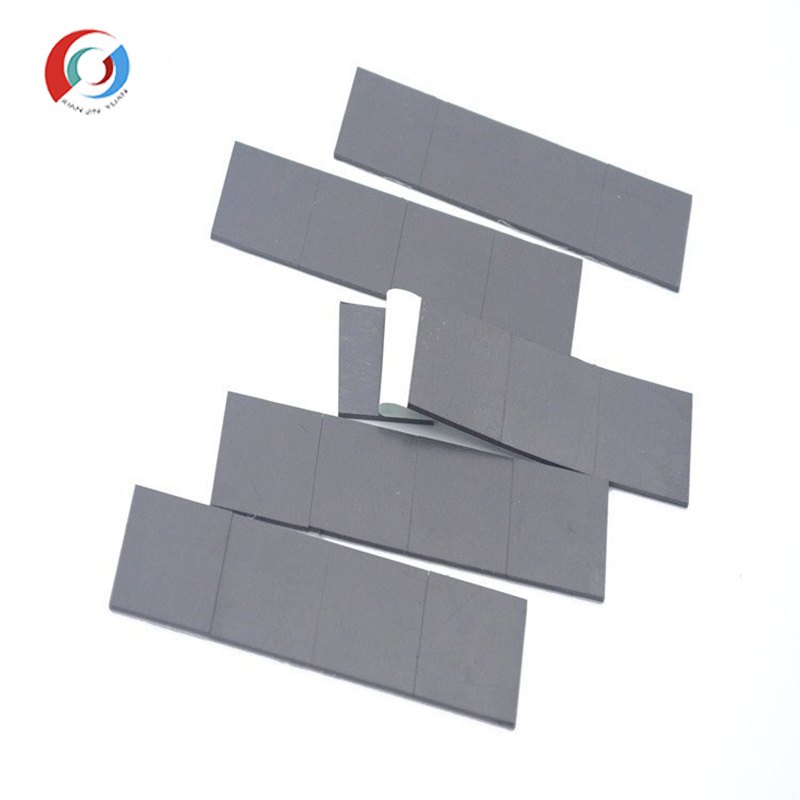
The significance of the existence of high permeability and low loss magnetic separators is to point out a "clear path" for magnetic field lines. Insert it between the coil and the metal component, and the magnetic field lines prefer to take this low magnetic resistance path, closing the loop inside the magnetic separator and no longer penetrating the metal layer behind. There is no longer any movement of cutting magnetic lines in the metal, and eddy current heating is effectively suppressed. Experimental data shows that suitable magnetic separators can improve the efficiency of wireless charging systems by 15% -30%.
2、 High permeability and low loss: a "dual engine" with a single magnetic separator
The performance advantage of high permeability and low loss magnetic separators is rooted in the synergy of two core parameters.
Magnetic permeability determines the material's ability to guide magnetic field lines. The higher the magnetic permeability, the easier it is for the material to allow magnetic flux lines to pass through - meaning that it can guide more magnetic flux at the same thickness or achieve the same magnetic conductivity effect at a thinner thickness. Materials with a magnetic permeability of 150 or higher are commonly used in NFC applications for smartphones. The high magnetic permeability enables the magnetic separator to achieve efficient magnetic flux guidance at ultra-thin thicknesses (up to a minimum of 30 μ m).
Magnetic loss is an indicator that measures the conversion of electromagnetic energy into thermal energy during the working process of materials. The lower the loss, the less energy waste, and the higher the charging efficiency. The magnetic separator also has a low loss factor to ensure that as many magnetic lines as possible can circulate, avoiding the reduction of near-field communication distance and efficiency due to magnetic flux loss.
The Yanbo brand high permeability and low loss magnetic isolation sheet is made of soft magnetic materials such as amorphous, nanocrystalline alloys, or ferrites. Taking nanocrystals as an example, these materials have extremely high magnetic permeability (μ=10 ⁴ -10 ⁵), extremely low iron loss (only 1/5-1/10 of silicon steel), ultra-thin (30 μ m-0.1mm), good flexibility, and can be punched, cut, and bent. After adopting nanocrystalline shielding sheets, a leading car company's 15kW wireless charging system efficiency has jumped from 88% to 93%, while controlling electromagnetic radiation values within 30% of international standards.
3、 From mobile phones to cars: the three major battlefields of high permeability and low loss magnetic isolation sheets
Smartphones and consumer electronics are the fields with the highest usage of magnetic separators. At the wireless charging receiving end of the mobile phone, a magnetic separator is attached between the coil and the metal back cover, which not only prevents eddy current heating, but also gathers magnetic flux to enhance induction strength. In NFC antenna applications, the magnetic separator restricts the magnetic flux generated by the reader/writer within the magnetic screen, avoiding induced currents on the metal surface and maintaining optimal 13.56MHz communication conditions. By 2025, the global production of amorphous magnetic separators has reached approximately 29 million pieces.
New energy vehicles and wireless charging in vehicles are the fastest-growing application directions. Vehicle mounted wireless charging requires higher power, wider temperature range, and higher reliability for magnetic separators. Nanocrystalline magnetic separators have demonstrated unique advantages in high-power vehicle wireless charging due to their high saturation magnetic flux density (approximately 1.2T) and low loss characteristics. Products such as in car NFC, smart cockpit, and smart wearables are becoming new growth poles for the demand for magnetic separators.
Electromagnetic compatibility and industrial equipment represent the application of magnetic separators in a wider range of fields. In equipment such as transformers and chokes, magnetic separators are used to guide and concentrate magnetic flux, improving equipment efficiency. The global ferrite shielding film market has reached a sales volume of 920 million US dollars in 2025 and is expected to grow to 1.469 billion US dollars by 2032.

4、 Selection points: How to choose the right magnetic separator for your device?
When selecting engineers, it is recommended to start from the following dimensions:
Frequency matching is the first principle. Ferrite is suitable for 100kHz-1MHz, while nanocrystals exhibit excellent performance in 50kHz-200kHz. 13.56MHz NFC applications require materials with high magnetic permeability (μ '>100). When selecting, it is necessary to ensure that it matches the operating frequency of the system.
The thickness and installation space determine feasibility. The thickness of the magnetic separator is usually between 0.1-0.4mm, and ultra-thin products can be as low as 30 μ m. The interior of mobile phones usually chooses ultra-thin models; Automotive electronics can choose slightly thicker specifications to meet higher power requirements.
The selection of material system is equally crucial. Ferrite has low cost but is hard, brittle, and prone to cracking; Nanocrystals have extremely high magnetic permeability, low loss, and good flexibility, and are gradually replacing traditional ferrite magnets; Amorphous materials have both high magnetic permeability and good processing adaptability.
Advanced Institute Technology provides full process technical support from material selection, sample trial production to batch delivery, helping customers incorporate magnetic isolation solutions into system considerations in the early stages of product design.
The global revenue from amorphous magnetic separators is expected to reach approximately 1.468 billion yuan in 2025, and is projected to approach 2.448 billion yuan by 2032. The market for nanocrystalline noise suppression chips is expected to grow to 329 million US dollars by 2032. Driven by the popularization of wireless charging for smartphones, the increasing penetration rate of wireless charging for new energy vehicles, and the accelerated penetration of NFC payment and access control, high permeability and low loss magnetic separators are moving from "professional material selection" to standard configurations for electronic device magnetic shielding and electromagnetic compatibility design.
Advanced Institute (Shenzhen) Technology Co., Ltd. will continue to deepen its cultivation in the field of high permeability and low loss magnetic separators, providing customers with higher performance and more reliable solutions for magnetic flux guidance and eddy current suppression through material innovation and precision technology.
 en
en  Español
 Français
 Português