1、 Anti common sense of low permeability absorbing materials: the lower the permeability, the better the high-frequency absorption
The performance improvement of traditional absorbing materials often follows a simple logic: the higher the magnetic permeability, the stronger the absorption capacity. This logic does hold in the low frequency range (MHz to several GHz) - high permeability materials can effectively guide and dissipate low-frequency electromagnetic waves. However, when the operating frequency climbs to the millimeter wave frequency band (above 24GHz), traditional magnetic materials are limited by the Snoek limit, and the magnetic permeability sharply decays with increasing frequency, resulting in a cliff like decline in absorption performance.
The design concept of low permeability absorbing materials precisely responds to this physical limitation. It no longer relies on high magnetic permeability to achieve absorption, but instead relies on dielectric loss as the dominant mechanism - converting electromagnetic wave energy into thermal energy through the dielectric polarization effect inside the material. Low magnetic permeability optimizes the impedance matching between the material and free space, allowing electromagnetic waves to smoothly enter the interior of the material rather than being reflected on the surface; Dielectric loss undertakes the task of efficiently dissipating incoming electromagnetic energy.
The global market for high-frequency RF absorbing materials has reached a production volume of 4 million square meters by 2025. With the continuous increase in operating frequencies of 5G millimeter wave and future 6G communication systems, low permeability absorbing materials are moving from "niche materials" to standard configurations for high-frequency electromagnetic compatibility design.
2、 From dielectric loss to impedance matching: the technical logic of low permeability absorbing materials
The performance of low permeability absorbing materials is rooted in the synergy of two core mechanisms - dielectric loss and impedance matching.
Dielectric loss is the core of energy conversion. The dielectric fillers in the material (such as carbon black, graphite, carbon nanotubes, etc.) undergo polarization in an alternating electric field, and the polarization lags behind the changes in the electric field, converting electromagnetic energy into thermal energy. Compared with magnetic losses, dielectric losses have more stable frequency response characteristics in the high frequency range - not constrained by Snoek limits. This allows low permeability absorbing materials to maintain considerable absorption capacity in the millimeter wave frequency band.
Impedance matching is the guarantee of absorption efficiency. Electromagnetic waves can only be effectively absorbed when they enter the interior of the material rather than being reflected on the surface. Low magnetic permeability combined with appropriately controlled dielectric constant matches the wave impedance of the material with free space. Research has shown that a significant difference in dielectric constant and magnetic permeability can lead to impedance mismatch; Low permeability absorbing materials achieve better impedance matching in the high frequency range through precise electromagnetic parameter control.
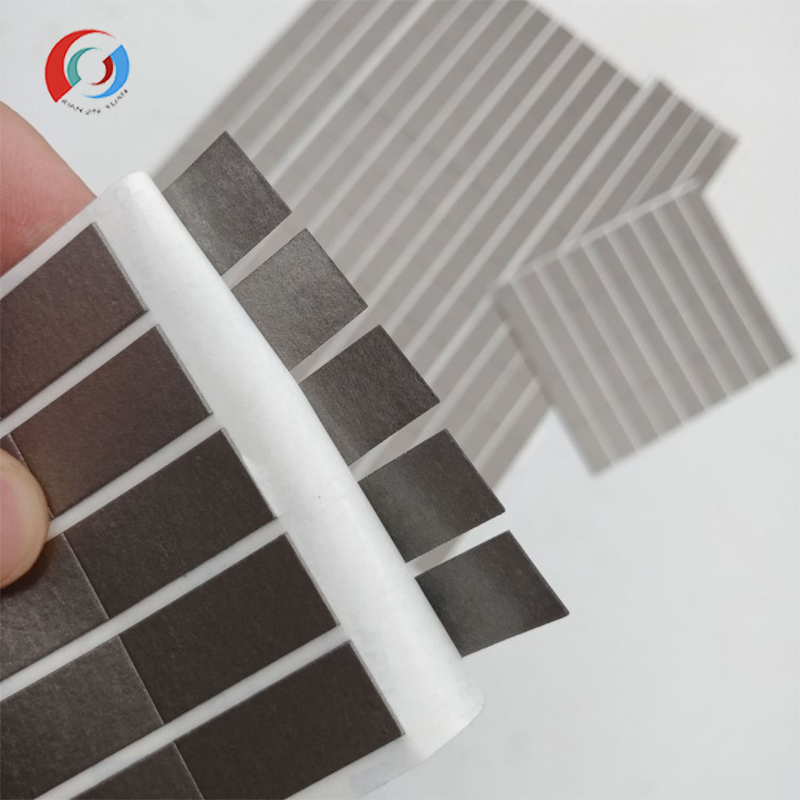
The low magnetic permeability absorbing materials of advanced technology are usually composed of a polymer matrix (such as epoxy resin, silicone rubber, etc.) and functional fillers. The matrix material provides structural support and flexibility; Dielectric fillers (carbon based materials) are responsible for enhancing dielectric loss; Magnetic fillers (ferrite, carbonyl iron powder, etc.) contribute limited magnetic losses. Through formula regulation, Advanced Institute Technology can perform precise optimization design for customers' specific high-frequency bands. The low permeability absorbing material of Yanbo brand has been widely used in the field of electromagnetic compatibility, which can significantly reduce the reflection of electromagnetic waves and improve the electromagnetic compatibility of equipment.
3、 Three core application scenarios: from 5G millimeter wave to high-speed digital circuits
5G/6G millimeter wave communication and RF front-end are the most urgent application areas for low permeability absorbing materials. The operating frequency of 5G millimeter wave and future 6G communication systems has climbed to 24GHz or even higher, and electromagnetic radiation interference between internal modules of devices has become a core challenge affecting system stability. Low permeability absorbing materials are widely used in millimeter wave antenna modules, RF front-end modules, filters, and other components due to their excellent impedance matching and dielectric loss characteristics in the high frequency range. They are used to absorb stray electromagnetic waves inside the cavity, suppress resonance, and reduce noise. There are cases showing that by using a specific high-frequency absorbing material scheme, the total radiation power of the 22GHz Retimer chip has been successfully reduced by about 17dB. For 5G communication, the material needs to effectively cover multiple frequency bands such as 2.4-5GHz.
Millimeter wave radar and automotive electronics are the fastest-growing application directions for low permeability absorbing materials. The operating frequency of vehicle mounted millimeter wave radar (24GHz, 77GHz and other frequency bands) imposes strict requirements on the frequency response of absorbing materials. Low permeability absorbing materials can be used inside radar modules to suppress cavity resonance, reduce sidelobe interference, and prevent ghosting. In high-speed digital circuits and signal integrity optimization scenarios, low permeability absorbing materials also play a key role - ensuring data transmission quality by absorbing high-frequency noise and reducing signal reflection.
Aerospace and military electronics represent the application fields with the highest reliability requirements for low permeability absorbing materials. In stealth technology, low permeability absorbing materials can be used to manufacture stealth coatings and stealth structural components, reducing radar reflection cross-section. Low permeability absorbing materials can be used in the design of aircraft, satellites, and other aerospace vehicles to reduce electromagnetic interference and the impact of electromagnetic radiation on the equipment. Compared with high permeability materials, low permeability absorbing materials are usually lighter in weight, which has important lightweight value for aerospace vehicles. Low permeability absorbing materials can also be applied in electromagnetic pollution prevention to improve environmental quality.
4、 Selection points and design suggestions
When engineers select low permeability absorbing materials, they need to focus on the following dimensions: matching the working frequency band - the optimal absorption frequency band for different material systems is different, and it needs to be matched according to the main interference frequency of the equipment (especially focusing on the millimeter wave frequency band); The balance between dielectric loss and magnetic loss - Low permeability absorbing materials are dominated by dielectric loss, but there are differences in the proportion of the two loss mechanisms in different formulations, which need to be evaluated according to specific application scenarios; The balance between thickness and absorption performance - it is necessary to find the optimal solution for thickness and absorption efficiency in a finite space; Environmental tolerance - requires evaluation of working temperature range, flame retardant rating, and weather resistance requirements; Customized requirements - Advanced Institute Technology supports precise optimization design for specific frequency bands. In multi-layer structure design, the composite use of high permeability materials and low permeability materials can form complementary effects, effectively widening the absorption frequency band.
Advanced Institute Technology provides full process technical support from material selection, performance testing to sample trial production and batch delivery, helping customers incorporate low magnetic permeability absorption solutions into electromagnetic compatibility considerations in the early stages of product design.
5、 Outlook
The global market for high-frequency RF absorbing materials is expected to continue expanding at a compound annual growth rate of 6.2%. The global market size of electromagnetic wave absorbing materials is expected to approach 3.02 billion yuan by 2030. Driven by the accelerated deployment of 5G/6G millimeter wave communication, the continuous increase in penetration rate of automotive millimeter wave radar, the rising frequency of high-speed digital circuits, and the upgrading of aerospace equipment, low permeability absorbing materials are moving from "professional selection" to standard configuration for electromagnetic compatibility design of high-frequency electronic devices.
At the same time, the industry is continuously evolving towards wider frequency bands, lower thickness, and stronger environmental adaptability. Machine learning assisted electromagnetic parameter design, multi-layer composite structure optimization, and development of new dielectric fillers are constantly expanding the performance boundaries of low permeability absorbing materials. With its comprehensive advantages in "high-frequency matching, broadband absorption, and lightweight", Yanbo brand low permeability absorbing materials will continue to play an irreplaceable key role in the fields of high-frequency communication and precision electronics.
Advanced Institute (Shenzhen) Technology Co., Ltd. will continue to deepen its cultivation in the field of low permeability absorbing materials, providing customers with higher performance and more reliable high-frequency electromagnetic compatibility solutions through material innovation and process optimization.
 en
en  Español
 Français
 Português