1、 Magnetic permeability: first principles of absorbing materials
The performance of electromagnetic wave absorbing materials ultimately depends on two core electromagnetic parameters: complex dielectric constant and complex magnetic permeability. For absorbing materials with magnetic loss as the main working mechanism, the real part (μ ') of magnetic permeability determines the material's ability to "guide" the magnetic field, while the imaginary part (μ') reflects the material's efficiency in converting electromagnetic energy into thermal energy.
The working principle of high permeability absorbing materials can be summarized in eight words: magnetic loss, not reflection. It not only reflects electromagnetic waves back like a shield, but also acts like a sponge, utilizing the high magnetic permeability and specific magnetic loss factor of the material to convert the invading electromagnetic wave energy into tiny thermal energy and dissipate it. This mechanism is particularly effective in suppressing internal resonance of devices and reducing reflection interference.
The value of high magnetic permeability is reflected in two aspects. In the low frequency range (MHz to GHz), high magnetic permeability means that materials can effectively guide and absorb electromagnetic waves at extremely thin thicknesses. This is crucial for scenarios where space is extremely limited, such as mobile phones and wearable devices - ultra-thin absorbing plates ranging from 0.03mm to 0.5mm can replace traditional absorbing materials that are several millimeters thick. In a wide frequency range, high magnetic permeability endows materials with better impedance matching characteristics, allowing electromagnetic waves to "enter" the interior of the material rather than being reflected on the surface, thereby achieving broad-spectrum absorption. The current commercial high permeability absorbing materials can cover a wide frequency band from 10MHz low frequency to 80GHz millimeter waves.
However, the permeability of traditional magnetic materials is physically constrained by the Snoek limit - there is a theoretical upper limit to the product of permeability and resonance frequency. Breaking through the Snoek limit has become the core proposition for high permeability absorbing materials to move from the laboratory to industrialization.
2、 From powder to sheet: the technological path of high permeability absorbing materials
High permeability absorbing materials are usually made by mixing, dispersing, and rolling micrometer sized flake alloy soft magnetic powders (such as FeSiAl, FeSiCr, carbonyl iron, etc.) with polymer matrices (such as silicone rubber, acrylic resin, etc.) as fillers. Soft magnetic alloys have shown great potential in the field of electromagnetic wave absorption in the gigahertz frequency band due to their high saturation magnetization, excellent magnetic permeability, rich magnetic loss mechanism, and adjustable electromagnetic parameters.
Fragmentation is a crucial step in breaking through Snoek's limits. Research has shown that after processing spherical soft magnetic alloy particles into sheet-like shapes, their shape anisotropy can effectively break through the Snoek limit, allowing the material to maintain high magnetic permeability in the GHz frequency band. The sheet-like powders overlap with each other in the same plane and direction, forming a core-shell structure. Harmful electromagnetic noise undergoes electromagnetic resonance and eddy current loss with the absorbing medium, which is converted into heat.
The orientation arrangement further amplifies the magnetic permeability advantage. By precision rolling, casting or molding processes, sheet powders are formed into ordered oriented structures in polymer matrices. The level of craftsmanship directly determines the consistency of product performance - if the powder is unevenly dispersed, it will form a "short board" in the magnetic circuit; If the molding density is not well controlled, the overall magnetic permeability will fluctuate. Advanced Institute Technology can control the magnetic permeability tolerance within a narrow range by continuously optimizing the thickness control and process parameters of the casting process, ensuring reliable performance of each batch of products.
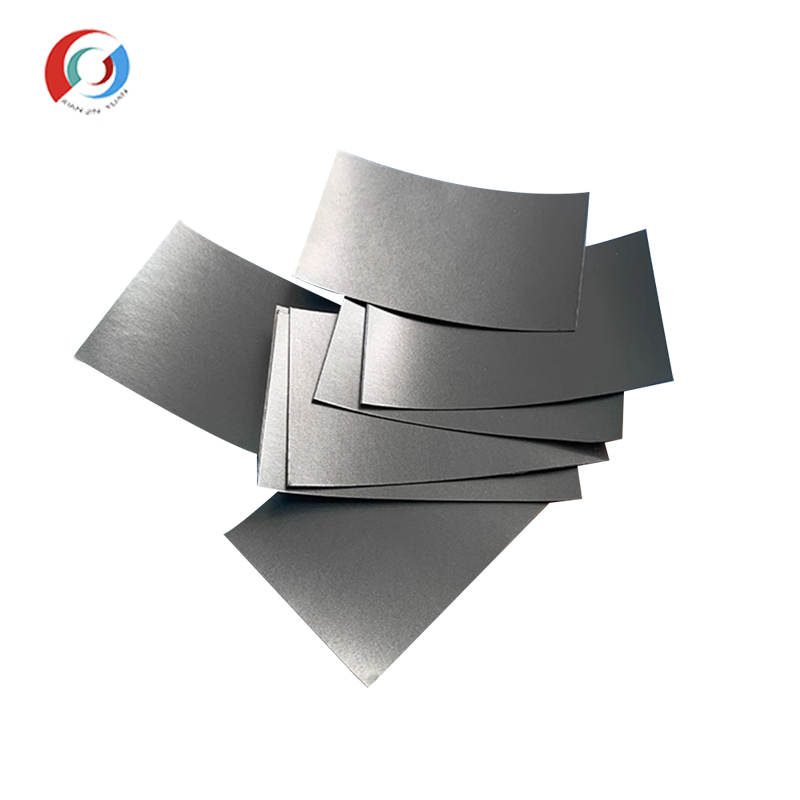
The choice of matrix determines the application boundary of the material. Using silicone rubber or acrylic resin as the matrix, endowing the material with excellent flexibility, die-cutting ability, and weather resistance. The applicable temperature range covers -40 ℃ to 150 ℃, meeting the stringent environmental requirements of automotive electronics, outdoor communication, etc. The surface resistance is usually greater than 10 ⁶ Ω to ensure insulation safety and comply with environmental directives such as halogen-free and RoHS. The material is soft and easy to die cut into different shapes and sizes. It can also be used with adhesive backing to simplify the installation process.
3、 Three core application scenarios: from consumer electronics to 5G base stations
Consumer electronics and wearable devices are the fields with the highest usage of high permeability absorbing materials. Smartphones, tablets, smartwatches, and other devices have limited internal space, but the electromagnetic environment is becoming increasingly complex - Bluetooth, WiFi, 5G sub-6GHz, NFC, and other multi-mode communications coexist in the same small space. The ultra-thin characteristics of high permeability absorbing materials (up to 0.03mm) enable them to be attached to key parts such as processors, antennas, camera modules, display driver chips, etc., effectively suppressing near-field noise and cavity resonance without increasing thickness. In RFID/NFC applications, high permeability absorbing materials can also solve the problem of reading distance attenuation when RFID tags are attached to metal surfaces. With the evolution of consumer electronics towards higher integration, the value of high permeability absorbing materials in improving antenna performance, reducing interference in specific frequency bands, and optimizing wireless charging efficiency is becoming increasingly prominent.
5G/6G communication devices represent the most technically demanding application direction. 5G communication has higher frequency bands, higher base station density, and higher integration of terminal equipment, which puts higher requirements on electromagnetic shielding. The existing 5G absorbing materials face the pain point of narrow coverage frequency band - it is difficult to meet the demand for new 5G frequency bands. High permeability absorbing materials exhibit unique advantages in base station filters, antenna modules, and equipment casings due to their broadband absorption properties. Inside a certain 5G AAU antenna module, engineers attached a layer of high magnetic permeability absorbing pad with a thickness of only 0.5mm on the inner wall of the shielding cover. At the 3.5GHz frequency point, the radiation peak caused by cavity resonance was suppressed by more than 8dB. With the launch of 6G research and the continuous increase in communication frequency, impedance matching and absorption efficiency of high permeability absorbing materials in the millimeter wave frequency band are becoming a new technological focus.
New energy vehicles and intelligent driving are the fastest-growing application directions. The demand for electromagnetic shielding in new energy vehicles is particularly urgent due to their high degree of electrification and complex electronic systems. Electric motors, electronic control units, onboard radars, and entertainment systems all face complex electromagnetic interference in high voltage and high current environments. Near the main control board of the battery management system in the battery pack, engineers used high permeability absorbing materials to make irregular structural components wrapped around key wiring harnesses. Actual testing found that it effectively reduced the coupling of high-frequency switch noise to the sampling circuit, reduced ADC sampling error by about 40%, and improved the safety boundary of battery management. Vehicle mounted millimeter wave radar (24GHz, 77GHz and other frequency bands), laser radar and other perception modules have extremely strict requirements for electromagnetic compatibility. High permeability absorbing materials can be used inside the radar module to suppress cavity resonance and reduce sidelobe interference. Global sales of new energy vehicles continue to rise, with the annual growth rate of the automotive absorbing material market exceeding 30%. The penetration rate of high permeability absorbing materials in the automotive electronics field has increased to 18.2%.
4、 Selection points and design suggestions
When selecting high permeability absorbing materials, engineers need to focus on the following dimensions: magnetic permeability and frequency band matching - the optimal working frequency band for different material systems is different, and it needs to be matched according to the main interference frequency of the equipment (from MHz to millimeter waves); Balance between thickness and absorption performance - In a limited space, it is necessary to find the optimal solution between thickness and absorption efficiency. The thickness range of 0.03mm to 0.5mm can cover most consumer electronics needs; Environmental tolerance - requires evaluation of working temperature range (-40 ℃ to 150 ℃), flame retardant rating (such as UL94 V-0), and weather resistance requirements; Installation method - whether adhesive backing is required, whether die-cutting is required to create a specific shape. After 1000 hours of high-temperature and high humidity aging at 85 ℃/85% RH, the magnetic permeability change rate of high-quality high permeability absorbing materials can be controlled within 5%.
Advanced Institute Technology provides full process technical support from material selection, performance testing to sample trial production and batch delivery, helping customers incorporate high permeability absorption solutions into electromagnetic compatibility considerations in the early stages of product design.
5、 Outlook
The global market for absorbing materials is continuously expanding at a compound annual growth rate of approximately 8% -9%. The global market size of radar absorbing materials is expected to be approximately $830 million by 2025, with magnetic absorbing materials accounting for nearly 46% of the market share due to their excellent performance in the low-frequency range. The vitality of the Chinese market is more significant, and the scale of the domestic absorbing material industry has grown rapidly from 9.2 billion yuan in 2019 to 15.2 billion yuan in 2024. More than 65% of the demand comes from the modernization of national defense and equipment upgrades, while the civilian sector - especially 5G/6G communication base stations, new energy vehicle electronic control systems, IoT devices, and high-end consumer electronics - is becoming an undeniable new growth pole.
Looking ahead to 2030, the global market size of absorbing materials is expected to approach 8 billion US dollars. By then, the proportion of demand in the civilian communication field is expected to increase to 36%, surpassing military defense as the largest application; The compound growth rate of new energy vehicles will remain above 15%. On the technical level, flexible absorbing materials and tunable absorbing devices are expected to enter the early stage of commercialization. The material system, preparation methods, and morphology design of soft magnetic alloys and their composite materials are showing a diversified development trend. In the future, the deep integration of material testing, performance simulation, and machine learning is expected to promote the efficient research and development of absorbing materials in this field.
Advanced Institute (Shenzhen) Technology Co., Ltd. will continue to deepen its cultivation in the field of high permeability absorbing materials, providing customers with higher performance and more reliable electromagnetic compatibility solutions through material innovation and process optimization.
 en
en  Español
 Français
 Português