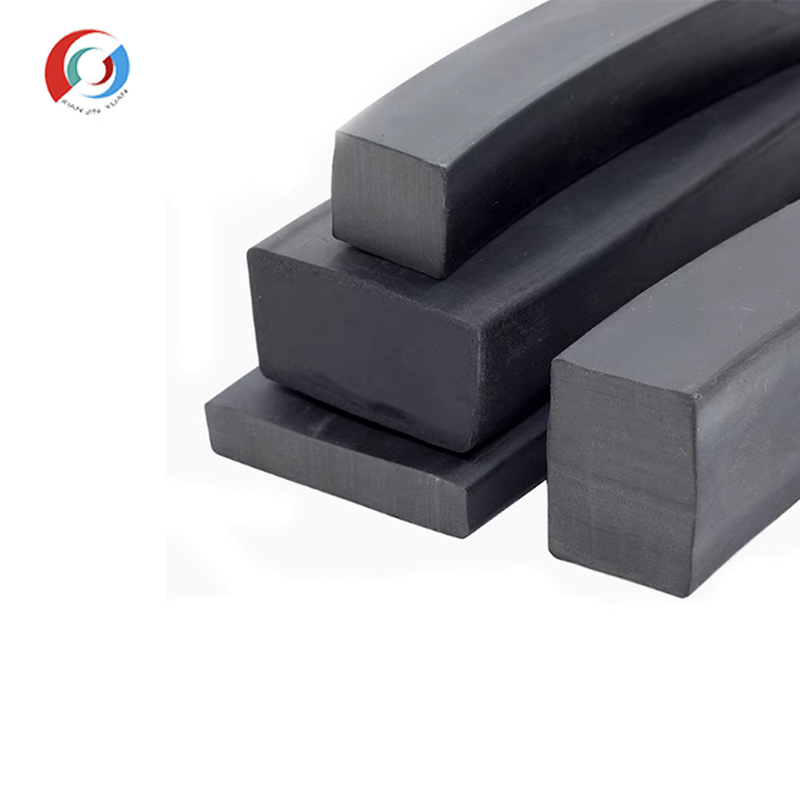
1、 The design logic of solid rectangular cross-section: why it is "solid" and why it is "rectangular"
The core function of conductive rubber strips is to form a continuous conductive path between two metal mating surfaces to achieve electromagnetic shielding and provide environmental sealing. Different cross-sectional shapes correspond to different installation scenarios and mechanical requirements - the design of rectangular solid conductive rubber strips precisely responds to the two most basic constraints in engineering practice: the adaptability of installation space and the reliability of closure pressure.
The value of a rectangular cross-section lies in its fitting efficiency. Compared with circular or O-shaped cross-sections, the flat top and bottom surfaces of rectangles can form a larger effective contact area with the installation plane, providing more stable sealing pressure and lower contact resistance under the same compression amount. This is particularly critical for scenarios that require flat sealing, such as cabinet door frames, panel interfaces, and electrical cabinets - the rectangular design makes the conductive rubber strip less likely to roll or shift after installation, and maintains stable position during long-term use. In small and medium-sized electronic chassis and microwave waveguide systems that require precise coordination, the advantage of consistent dimensions of rectangular cross-sections is more prominent.
The value of solid structures lies in their durability and reliability. Solid conductive rubber strips can withstand high closing forces and environmental pressures, meeting strict requirements for repeated opening and closing. Solid structures adapt to pressure by changing their shape rather than volume, maintaining stable sealing and shielding performance through repeated compression rebound cycles. In scenarios such as cabinet doors and maintenance covers that require frequent opening and closing, the durability advantage of solid structures is particularly prominent - especially for automotive OEMs who require conductive elastomer gaskets to maintain a contact resistance of less than 1 Ω during 100000 opening and closing cycles and withstand high temperatures inside the cabin at 125 ℃.
2、 From filler selection to performance realization: synergy between conductive network and elastic matrix
The performance of rectangular solid conductive rubber strips is rooted in their material composite system. It is based on silicone rubber or fluorosilicone rubber, and forms a three-dimensional conductive network by uniformly filling conductive particles (such as copper silver plating, aluminum silver plating, glass silver plating, nickel carbon, pure silver, etc.). Conductive silicone rubber has been widely used in industries such as electronics, aerospace, automotive, and telecommunications, and is a key material for electromagnetic interference shielding, sealing gaskets, and conductive gaskets.
In this system, the silicone rubber matrix provides elastic recovery, weather resistance, and sealing durability, with a working temperature range covering -55 ℃ to 160 ℃. The fluorosilicone rubber system is more resistant to the erosion of fuel and solvents. Conductive fillers are responsible for establishing low resistance conductive pathways. The synergy of the two functions enables the rectangular solid conductive rubber strip to maintain stable electrical contact and effective barrier against water vapor and dust under compression.
Different filler systems correspond to different ranges of volume resistivity and shielding effectiveness: silver plated copper systems can achieve the order of 0.002-0.004 Ω· cm, silver plated aluminum is about 0.008-0.012 Ω· cm, and nickel plated graphite is usually in the range of ≤ 0.1 Ω· cm. The lower the value, the easier it is theoretically to establish a stable conductive channel under low pressure. In terms of shielding effectiveness, typical products of rectangular solid conductive rubber strips can achieve 100-120dB in the 100MHz-2GHz range, and most still maintain above 90-100dB at 10GHz. Carbon nanotube conductive silicone rubber, as a new type of electromagnetic shielding material, is increasingly being used in industries such as radar, communication, and electronic equipment due to its excellent high-frequency shielding effectiveness and sealing properties. Advanced Institute Technology can flexibly select packing systems and cross-sectional dimensions based on customer requirements for shielding frequency bands, flange compression stroke, and cost budgets.
3、 Three core application scenarios: from communication cabinets to military equipment
The military and aerospace industries require the highest technical standards for rectangular solid conductive rubber strips. The application of rectangular solid conductive rubber strips in the military industry can be traced back to the US military standard MIL-DTL-83528 (formerly MIL-G-83528), which establishes general requirements for conductive elastomer shielding gaskets. Conductive elastomer gaskets are highly conductive, mechanically elastic, and compressible vulcanized gaskets that provide low interface resistance between mating electronic chassis flanges or covers, while achieving moisture resistance, pressure resistance, or environmental sealing. The rectangular solid conductive rubber strip of Advanced Institute Technology is widely used in small and medium-sized military electronic chassis and microwave waveguide systems, as well as in military shelters and electronic equipment such as aerospace, aviation, and ships. In these application scenarios, it can replace traditional sealing rubber and perform both environmental and electromagnetic sealing functions. The concise design of the rectangular cross-section makes it particularly suitable for military and aerospace equipment that requires long-term stable service.
Communication equipment and data centers are one of the areas with the highest demand for rectangular solid conductive rubber strips. In 5G base stations, communication cabinets, and data center server chassis, the gap between cabinet doors and cabinets is the main electromagnetic leakage channel. Rectangular solid conductive rubber strips are widely used in cabinet door sealing grooves, which not only prevent external electromagnetic interference from entering the interior of the cabinet and affecting equipment operation, but also suppress internal electromagnetic radiation leakage to the external environment. A single seam simultaneously completes EMI shielding and environmental sealing, eliminating the need for a two-piece solution of "metal spring and rubber strip" and avoiding potential differences and accumulated assembly tolerances between the two sets of parts. Conductive silicone rubber sealing strips play a crucial role in communication equipment, server cabinets, and other scenarios.
New energy vehicles and industrial control represent the fastest-growing application directions. The electrical architecture of new energy vehicles poses a dual challenge to electromagnetic compatibility and sealing protection. The rectangular solid conductive rubber strip between the battery management system (BMS) and the vehicle body not only prevents moisture and dust from entering sensitive circuits, but also ensures a low impedance grounding path between the battery pack and the vehicle body. The advantage of the rectangular cross-section in the sealing of the electronic control unit (ECU) housing makes installation more reliable. In the global EMI shielding gasket market, gasket shielding methods will occupy 53.15% of the market share by 2025. In the fields of industrial control chassis, medical diagnostic equipment, etc., rectangular solid conductive rubber strips are also widely used in scenarios that require both EMI shielding and sealing protection.
4、 Selection points and design suggestions
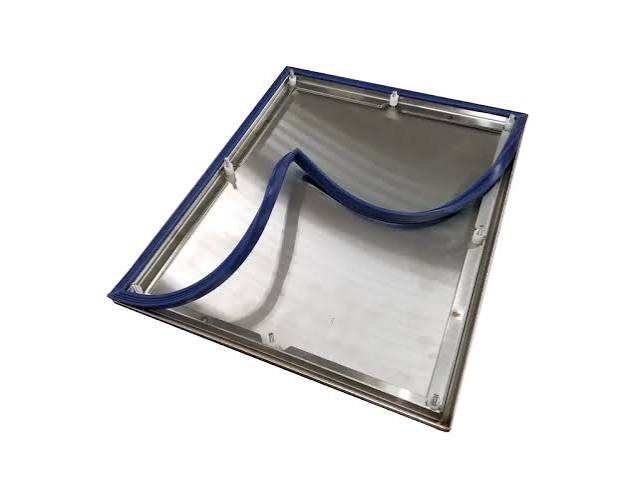
When selecting rectangular solid conductive rubber strips, engineers need to focus on the following dimensions: filler system and conductivity - different fillers correspond to different volume resistivity and shielding effectiveness, which need to be matched according to the EMC requirements of the equipment; Hardness and permanent deformation under compression - The recommended compression rate for solid bars is 7% -15%. Overpressure may cause the conductive particle pathways to scatter and accelerate permanent deformation. Under the condition of 70h × 100 ℃, the compression permanent deformation of high-quality products can be controlled within 30% -45%; Environmental tolerance - requires assessment of working temperature range, chemical corrosion risk, and UV exposure level; Installation method - whether adhesive fixation is required, whether on-site cutting or die-cutting is needed.
It should be noted that the contact surface must be conductive - if the flange surface is anodized or non-conductive sprayed without exposing copper/aluminum locally, the conductive rubber strip cannot form effective conductivity when pressed on. In addition, for application scenarios that pursue higher integration, the co extrusion of conductive rubber strips can also be considered, which combines conductive elastomers with pure silicone through co extrusion technology to optimize sealing performance and environmental adaptability while maintaining EMI shielding effectiveness.
Advanced Institute Technology provides full process technical support from cross-sectional design, material selection to sample trial production and batch delivery, helping customers incorporate conductive sealing solutions into system considerations in the early stages of electromagnetic compatibility design.
5、 Outlook
The global sales revenue of conductive rubber gaskets has reached 3.449 billion yuan in 2025, and is expected to grow to 4.694 billion yuan in 2032. The global extruded EMI shielding gasket market is expected to continue expanding at a compound annual growth rate of 7.28%, and is expected to exceed 1.06 billion US dollars by 2032. Driven by the continuous deployment of 5G/6G communication infrastructure, the deep evolution of automotive electrification and intelligence, and the accelerated upgrading of aerospace equipment, rectangular solid conductive rubber strips with dual functions of electromagnetic shielding and environmental sealing are moving from "professional material selection" to the standard configuration of electronic equipment electromagnetic compatibility design.
At the same time, the industry is evolving towards finer refinement - the nanomodification of conductive fillers, continuous improvement in extrusion accuracy, and optimization of shielding effectiveness for higher frequency bands (millimeter waves) are constantly expanding the performance boundaries of rectangular solid conductive rubber strips. Conductive elastomer gaskets are increasingly becoming an indispensable key material in the aerospace, automotive, and telecommunications industries. Advanced Institute (Shenzhen) Technology Co., Ltd. will continue to deepen its expertise in the field of conductive elastomers, providing customers with higher performance and more reliable conductive sealing solutions through material innovation and process optimization.
 en
en  Español
 Français
 Português