1、 Why is it necessary to "isolate magnetism" - the technical pain points from eddy current heating to signal attenuation
In wireless charging systems, energy is transmitted through changes in magnetic flux between the transmitting coil and the receiving coil. However, the magnetic field does not propagate along an ideal path - it spreads outwards in a divergent spherical or circular shape. When this part of the "leakage flux" encounters metal components such as the metal back panel of a smartphone, battery case, or car chassis, induced eddy currents will be generated inside the metal.
The problems caused by eddy currents have two levels. At the level of thermal management, eddy currents convert electromagnetic energy into thermal energy, causing metal components to heat up - this is the fundamental reason why many users complain about "overheating during wireless charging of mobile phones". Eddy current heating not only reduces charging efficiency, but may also accelerate battery aging. At the electromagnetic compatibility level, the reactive magnetic field generated by eddy currents can interfere with the original magnetic coupling path, leading to a decrease in charging power, NFC card swiping failure, and touch screen misoperation. In NFC applications, metal objects can absorb or interfere with the magnetic flux lines generated by the magnetic field, forming eddy currents, thereby reducing the effective range and even making communication impossible.
The value of high permeability and low loss magnetic separators lies in solving these two problems from the source. It inserts high permeability materials between the coil and metal components, providing a low magnetic resistance path for magnetic field lines that is "more willing to travel" than air and metal. The magnetic field lines are guided in a closed loop inside the magnetic separator, no longer penetrating the metal layer behind, and there is no longer any movement of cutting magnetic induction lines in the metal, effectively suppressing eddy current heating. At the same time, the magnetic separator binds the magnetic field in a specific path, reducing "leakage flux" and ensuring that wireless charging and NFC communication do not interfere with each other.
2、 High permeability and low loss: a "dual engine" with a single magnetic separator
The performance advantage of high permeability and low loss magnetic separators is rooted in the synergy of the two core parameters of "high permeability" and "low magnetic loss".
Magnetic permeability is a physical quantity that measures a material's ability to guide magnetic field lines. The higher the magnetic permeability, the easier it is for the material to allow magnetic lines to pass through. High magnetic permeability means that more magnetic flux can be guided at the same thickness, or the same magnetic permeability can be achieved at a thinner thickness. The IFQ06 series flexible magnetic sheets launched by TDK have a relative magnetic permeability (μ ') of up to 56 at 13.56MHz; The magnetic permeability of nanocrystalline magnetic separators can reach 500-1000. The high magnetic permeability enables the magnetic separator to achieve efficient magnetic flux guidance at ultra-thin thicknesses (up to a minimum of 30 μ m). Research has shown that in transmitter applications, the excellent magnetic conductivity of magnetic separators can significantly increase coil magnetic flux, reduce copper wire losses, and improve electromagnetic conversion efficiency; At the receiving end, the magnetic isolation sheet is attached between the coil and the metal back cover, effectively isolating the absorption and attenuation of electromagnetic signals by the metal, gathering magnetic flux to enhance induction intensity.
Magnetic loss is an indicator that measures the conversion of electromagnetic energy into thermal energy during the working process of materials. The lower the magnetic loss, the less energy waste and the higher the charging efficiency. High permeability and low loss magnetic separators reduce eddy current losses by optimizing material composition and microstructure. For example, adding Ca ² ⁺ to manganese zinc ferrite can enrich amorphous intermediate phases at grain boundaries, increase grain boundary resistivity, thereby improving the resistivity of the magnetic core and reducing losses. Low magnetic loss enables the magnetic isolation sheet to maintain a lower operating temperature in high-power wireless charging scenarios, providing additional redundancy for system thermal management.
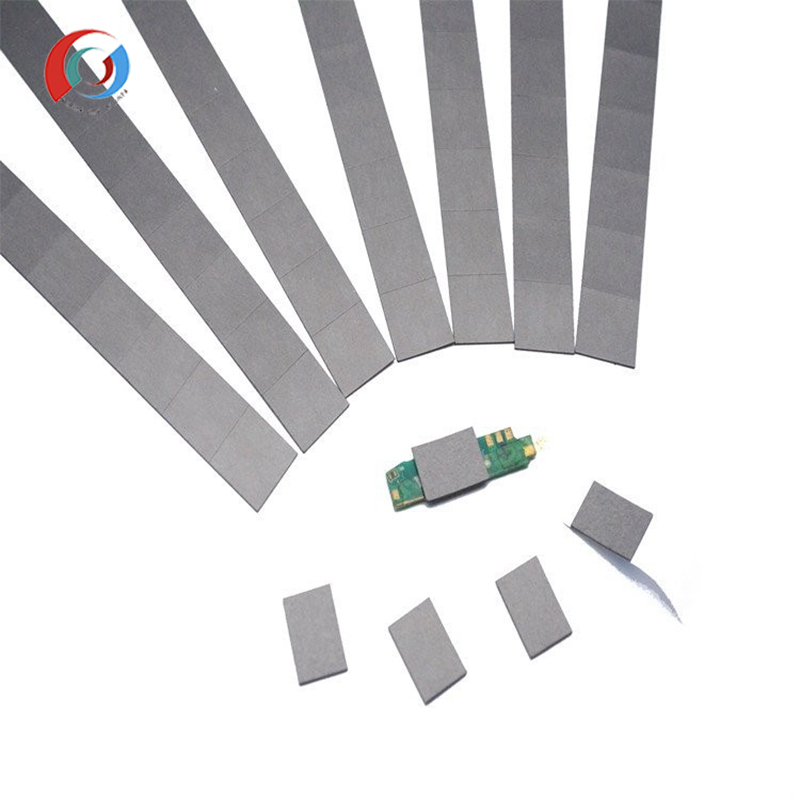
The research platinum brand high permeability and low loss magnetic isolation sheet launched by Advanced Institute Technology is made of soft magnetic materials such as amorphous, nanocrystalline alloys or ferrites, and achieves thickness consistency and precision control through precision coating technology. The product has a magnetic permeability coverage of 15 to 250 or more, and the thickness can be customized according to customer needs, with a minimum of 30 μ m. The product has the characteristics of high magnetic permeability, low magnetic loss, and good temperature stability. Its surface resistivity is greater than 10M Ω and it can directly contact metal antennas.
3、 The Evolution of Material Systems: From Ferrites to Nanocrystals
The material selection of the magnetic separator directly determines its performance boundary. The current industry mainly adopts three material systems.
Ferrite magnetic separators are the most traditional solution. Manganese zinc ferrite and nickel zinc ferrite have the advantages of good insulation, no eddy current, high frequency stability, low cost, moderate magnetic permeability (500-3000), and stable performance in the frequency range of 100kHz to 1GHz. However, the disadvantages of ferrites are also obvious: they are hard, brittle, and brittle, cannot be bent, have a low saturation magnetic flux density (about 0.4-0.5T), and are prone to saturation at high power. In scenarios such as mobile phones that require ultra-thin and flexible design, ferrite is gradually being replaced by new materials.
Amorphous/nanocrystalline alloy magnetic separators are currently the fastest-growing technological route. The amorphous magnetic separator is made of amorphous alloy and has an atomic long-range disordered structure. The typical product structure consists of four parts: protective film, amorphous magnetic material layer, double-sided tape, and release film. The nanocrystalline magnetic separator adopts iron-based nanocrystals (such as Finemet, 10nm grain size), which have extremely high magnetic permeability (μ=10 ⁴ -10 ⁵), extremely low iron loss (only 1/5-1/10 of silicon steel), ultra-thin (30 μ m-0.1mm), good flexibility, and can be punched, cut, and bent. It performs well at high frequencies (1kHz-10MHz). Nanocrystals have significant advantages in high-power wireless charging scenarios by balancing high saturation magnetic flux density (about 1.2T) and high magnetic permeability. After adopting nanocrystalline shielding sheets, a leading car company's 15kW wireless charging system efficiency has jumped from 88% to 93%, while controlling electromagnetic radiation values within 30% of international standards. Due to its excellent soft magnetic properties and ultra-thin thickness, nanocrystalline magnetic sheets have become the mainstream magnetic shielding material solution for wireless charging receivers in mobile phones. At present, mass production of nanocrystalline soft magnetic alloy strips with a minimum thickness of only 12 microns has been achieved in China, and they occupy an important share in the wireless charging core magnetic materials of mainstream mobile phone brands.
Soft magnetic composite materials balance complex shape forming and high-frequency performance, and can be molded into complex 3D shapes with extremely low eddy current losses. They are stable at high frequencies (1kHz-100MHz), but have low magnetic permeability (20-300).
Advanced Institute Technology can flexibly select material systems and processing techniques based on customers' different requirements for operating frequency bands, power levels, thickness, and flexibility, providing a full range of magnetic isolation sheet products from ferrite to nanocrystals.
4、 Three core application scenarios: from smartphones to new energy vehicles
Smartphones and consumer electronics are the fields with the highest usage of high magnetic permeability and low loss magnetic isolation sheets. In the wireless charging receiver module of mobile phones, the magnetic isolation sheet is attached between the coil and the metal back cover, which not only prevents eddy current heating, but also gathers magnetic flux to enhance induction intensity. In NFC antenna applications, the magnetic separator restricts the magnetic flux generated by the reader/writer within the magnetic screen, avoiding induced currents on the metal surface and maintaining optimal 13.56MHz communication conditions. With the evolution of wireless charging power for mobile phones from 15W to 50W, higher requirements have been put forward for the saturation magnetic flux density and thermal management capability of magnetic separators. In terminal devices such as smartphones, wearable devices, tablets, and smart cards, the coil is easily affected by metal components and complex electromagnetic environments. Amorphous magnetic separators can guide magnetic fields, reduce eddy current losses, and improve energy transmission efficiency.
New energy vehicles and wireless charging in vehicles are the fastest-growing application directions. The wireless charging scenario for vehicles requires higher power, wider temperature range, and higher reliability for magnetic separators. In the wireless charging system of electric vehicles, the commonly used Mn Zn ferrite magnetic shielding material has the problem of low saturation magnetic density in high-power energy transmission systems, which is difficult to meet safety requirements. Nanocrystalline magnetic separators have demonstrated unique advantages in high-power vehicle wireless charging due to their high saturation magnetic flux density (approximately 1.2T) and low loss characteristics. The global market for wireless charging soft magnetic chips for vehicles is expected to reach approximately $155 million by 2025 and is projected to grow to $564 million by 2032, with a compound annual growth rate of 20.6%. Products such as in car wireless charging, intelligent cabins, and smart wearables are becoming new growth poles for the demand for magnetic separators.
Electromagnetic compatibility and industrial equipment represent the application of magnetic separators in a wider range of fields. Inside electronic devices, magnetic separators are used to prevent external electromagnetic interference from affecting the normal operation of the device. In equipment such as transformers, chokes, and magnetic amplifiers, magnetic separators are used to guide and concentrate magnetic flux, improving equipment efficiency. In medical imaging devices such as MRI, magnetic separators are used to optimize magnetic field distribution and improve imaging quality. The growth of the global ferrite shielding film market is mainly driven by the rapid development of consumer electronics, the popularization of wireless charging, and the continuous improvement of electromagnetic compatibility requirements. The trend of miniaturization and high power density of electronic devices has exacerbated electromagnetic interference problems, further stimulating the demand for high-performance shielding materials.
5、 Selection points and design suggestions
When selecting high permeability and low loss magnetic separators, engineers need to focus on the following dimensions: matching working frequency and magnetic permeability - the optimal working frequency band for different material systems is different, and there is a significant difference in magnetic permeability requirements between 13.56MHz NFC applications and 100kHz wireless charging applications; Power level and saturation magnetic flux density - High power wireless charging requires higher saturation magnetic induction intensity to prevent performance degradation caused by magnetic saturation; Thickness and installation space - ultra-thin (30-100 μ m) is suitable for extremely limited space scenarios such as mobile phones, and the optimal thickness needs to be determined based on the actual gap tolerance; Flexibility requirements - For applications that require adherence to curved surfaces or repeated bending, flexible nanocrystalline magnetic separators are superior to hard and brittle ferrite solutions.
Advanced Institute Technology provides full process technical support from material selection, performance testing to sample trial production and batch delivery, helping customers incorporate high permeability and low loss magnetic isolation solutions into their system considerations in the early stages of product design.
6、 Outlook
The global amorphous magnetic separator market is expected to continue expanding at a compound annual growth rate of 6.5% -6.9%, with revenue reaching nearly 2.448 billion yuan by 2032. The global market for ferrite shielding sheets is expected to reach $1.469 billion by 2032. Driven by the continuous improvement of wireless charging power, the lightweight and multifunctional development of consumer electronics, and the deep evolution of automotive electrification and intelligence, magnetic separators with high magnetic permeability and low magnetic loss are moving from "professional material selection" to standard configurations for electronic device magnetic shielding and electromagnetic compatibility design.
At the same time, the industry is continuously evolving towards thinner, softer, higher saturation magnetic flux density, and lower losses. The introduction of nanocrystalline technology has significantly improved the magnetic permeability and saturation magnetic induction intensity of materials, making ultra-thin and flexible magnetic separators the mainstream in the market. The future market competition will focus on material consistency, thickness control, magnetic permeability stability, heat resistance, die-cutting processing, and customer customization capabilities. High permeability and low loss magnetic isolation sheets, with their comprehensive advantages in the four dimensions of "permeability, isolation, low loss, and lightweight", will continue to play an irreplaceable key role in wireless charging, NFC communication, new energy vehicles, and electromagnetic compatibility.
Advanced Institute (Shenzhen) Technology Co., Ltd. will continue to deepen its cultivation in the field of high permeability and low loss magnetic separators, providing customers with higher performance and more reliable magnetic shielding and flux guidance solutions through material innovation and process optimization.

 en
en  Español
 Français
 Português