1、 Heat and disturbance in the millimeter wave era: why traditional thermal pads are inadequate
The operating frequency of 5G millimeter wave communication has increased several times or even tens of times compared to the sub-6GHz frequency band, which has brought about a series of chain reactions. The power amplifiers (such as GaN or LDMOS devices) and antenna modules in the RF front-end module have higher operating frequencies and higher heating power. At the same time, the integration of devices has greatly improved, and the internal space has become more compact, making it easy for heat to accumulate and unable to dissipate quickly. Each antenna unit in a Massive MIMO array contains power electronics that need to transfer heat from the amplifier to a metal casing or heat spreader.
The traditional thermal pad exposes two fatal shortcomings in this scenario.
Dielectric loss leads to signal attenuation. Ordinary thermal pads are often filled with a large amount of ceramic or metal oxide fillers in order to pursue high thermal conductivity. Although these fillers have excellent thermal conductivity, they significantly increase the dielectric constant and dielectric loss factor of the material - when high-frequency millimeter wave signals pass through the gasket, some of the signal energy is absorbed or reflected, resulting in a decrease in antenna efficiency and fluctuations in radar detection performance. The millimeter wave frequency band is extremely sensitive to the dielectric properties of materials, and a dielectric loss factor of 0.001 for modified PTFE material can cause a signal attenuation of 2.1dB/cm in the 24GHz frequency band.
It is difficult to minimize the thermal resistance. The gap between the internal chip and the heat dissipation structure of millimeter wave devices is often only tens to hundreds of micrometers. At this scale, the proportion of contact thermal resistance to total thermal resistance increases sharply. Traditional thermal pads have high hardness and are difficult to fully fill micro uneven interfaces under low pressure, resulting in high thermal resistance.
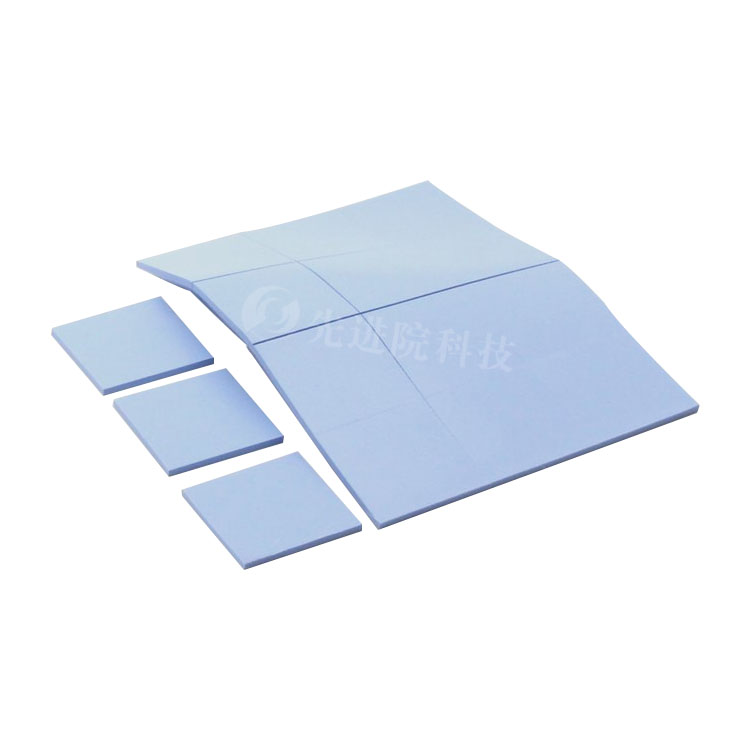
2、 The "technical threshold" of millimeter waveguide thermal pad: low dielectric, low loss, low thermal resistance
The reason why 5G millimeter waveguide thermal pads are defined as an independent product category is because they have achieved systematic breakthroughs in multiple performance dimensions compared to traditional thermal pads.
Low dielectric constant and low dielectric loss are the core thresholds. Millimeter waveguide thermal pads need to be optimized through formulation to reduce the dielectric constant (Dk) and dielectric loss factor (Df) of the material, in order to minimize energy loss of electromagnetic waves during transmission. Some products designed specifically for 5G millimeter wave communication focus on reducing Dk and Df in RF modules during the research and development phase to minimize interference. In the millimeter wave frequency range (24-40GHz, 40-75GHz, and even 76-110GHz), the stability of the dielectric properties of the material directly determines the signal integrity.
Low thermal resistance is the guarantee of heat dissipation efficiency. Millimeter waveguide thermal pads need to achieve the lowest possible interface thermal resistance while ensuring low dielectric loss. Some thermal conductivity gel pads specially designed for millimeter wave scenarios have a thermal conductivity of 5.0W/m.K. The gasket should be able to tightly adhere to heating devices such as chips and RF modules, quickly absorb heat and effectively conduct it to the heat dissipation area.
The stability of high-frequency signals is equally crucial as low ion impurities. The millimeter wave frequency band places higher demands on the purity of materials - trace amounts of ion impurities may cause dielectric performance drift, affecting the long-term reliability of equipment. Millimeter waveguide thermal pads need to meet requirements such as low ion impurities and high frequency signal stability.
The 5G millimeter wave waveguide thermal pad from Advanced Institute Technology finds the optimal balance point between thermal conductivity, dielectric constant, and dielectric loss through precise filler compounding and matrix modification, providing a low thermal resistance and low loss thermal conduction path from the chip to the heat sink for millimeter wave communication equipment.
3、 Three core application scenarios: from millimeter wave base stations to vehicle mounted radar
The 5G millimeter wave base station and RF front-end module are the core application areas of 5G millimeter wave waveguide thermal pads. The core components such as power amplifiers and transceivers in 5G base stations, micro base stations, and RF front-end modules generate a large amount of heat during high-frequency operation. The millimeter waveguide thermal pad is placed between the power amplifier chip and the metal heat dissipation shell/cold plate, effectively filling the micro gap, reducing contact thermal resistance, ensuring stable operation of RF devices in high temperature environments, and preventing performance degradation, frequency drift, or shortened lifespan caused by overheating. The global market for 5G thermal conductive materials is expected to grow from $699 million in 2025 to $2.122 billion in 2035. The deep application of millimeter wave frequency band and the explosion of AI models are driving the power consumption of a single chip to cross the threshold of 1000W - traditional thermal conductive materials are being replaced by higher performance alternatives.
Automotive millimeter wave radar is one of the fastest-growing application directions for 5G millimeter wave waveguide thermal pads. The operating frequency of vehicle mounted millimeter wave radar (24GHz, 77GHz and other frequency bands) coincides with the height of 5G millimeter wave, and the performance requirements for thermal conductive materials are equally strict. Millimeter waveguide thermal pads are mainly used to fill the small gaps between radar RF chips and heat dissipation shells, achieving heat conduction and stress buffering. In millimeter wave radar modules, the gasket also needs to meet the requirements of low dielectric loss and high-frequency signal stability to avoid fluctuations in radar detection performance.
Satellite communication and high-frequency RF equipment represent the application areas with the highest reliability requirements for 5G millimeter waveguide thermal pads. The low orbit satellite communication system operates in frequency bands such as 12-18GHz, and the RF module inside the satellite cabin faces more severe thermal management challenges in a vacuum environment. Millimeter waveguide thermal pads need to have low gas release, wide temperature range stability, and high-frequency low loss characteristics to ensure the long-term reliable operation of satellite communication equipment in extreme environments.
4、 Selection points and design suggestions
When selecting 5G millimeter waveguide thermal pads, engineers need to focus on the following dimensions: balance between dielectric performance and thermal conductivity - different application scenarios have different priorities for dielectric loss and thermal conductivity, which need to be matched according to specific RF performance and heat dissipation requirements; Matching of working frequency band - Millimeter wave frequency band covers 24-110GHz, and there are differences in the dielectric performance requirements of materials in different frequency bands; Thickness and compressibility - The internal gap of millimeter wave equipment is usually between 0.3-5.0mm, and the gasket needs to achieve the optimal thermal resistance under the target compression amount; Environmental tolerance - requires evaluation of operating temperature range, flame retardant rating (such as UL94 V-0), and long-term reliability requirements.
Advanced Institute Technology provides full process technical support from material selection, performance testing to sample trial production and batch delivery, helping customers incorporate thermal pad solutions into system considerations in the early stages of millimeter wave equipment design.
5、 Outlook
By 2025, the global sales of millimeter waveguide thermal pads will be approximately 350000 square meters, with an average market price of around 850 US dollars per square meter. It is expected that by 2032, the global market size of millimeter waveguide thermal pads will reach 658 million US dollars, with a compound annual growth rate of 12.0%. Driven by the continuous deployment of 5G millimeter wave infrastructure, the increasing penetration rate of automotive millimeter wave radar, the accelerated commercialization of low orbit satellite communication, and the launch of 6G technology research and development, millimeter wave thermal pads are moving from "professional material selection" to standard configuration for thermal management of high-frequency communication equipment.
At the same time, the industry is continuously evolving towards higher thermal conductivity, lower dielectric loss, and thinner and softer materials. The integration of thermal conductivity and absorption materials is becoming a trend - a single material simultaneously solves the dual needs of heat dissipation and electromagnetic compatibility. A research team has developed a 5G millimeter waveguide thermal absorption integrated material, dedicated to solving problems such as "overweight, excessive thickness, narrow absorption bandwidth, and low thermal conductivity" of the material. Thermal pads with multifunctional integration capabilities are more likely to enter the high-end electronic design list. The 5G millimeter wave waveguide thermal pad, with its comprehensive advantages in four dimensions of "low dielectric, low loss, low thermal resistance, and high frequency stability", will continue to play an irreplaceable key role in the era of millimeter wave communication.
Advanced Institute (Shenzhen) Technology Co., Ltd. will continue to delve into the field of 5G millimeter waveguide thermal pads, providing customers with higher performance and more reliable high-frequency thermal management solutions through material innovation and process optimization.
 en
en  Español
 Français
 Português