In the field of superconducting technology, breakthroughs in material properties often determine the boundaries of application scenarios. When the high temperature resistance and insulation properties of polyimide (PI) film are combined with the superconducting properties of niobium titanium alloy (NbTi), a composite material called PI coated niobium titanium film has emerged. This material not only breaks through the physical limits of traditional superconducting materials, but also opens up new possibilities in fields such as energy, healthcare, and scientific research. A well-known enterprise in Xi'an recently purchased PI coated niobium titanium thin film customized by Advanced Institute Technology, which is a typical case of this material moving from laboratory to industrialization.
1、 Technological breakthrough: "Performance superposition effect" of PI and NbTi
1.1 PI film: the "ideal carrier" for superconducting substrates
PI film is known as the "golden film", and its core advantages lie in its extremely wide temperature adaptability (-269 ℃ to 400 ℃) and excellent electrical insulation performance. In superconducting applications, traditional substrates such as copper or aluminum are prone to brittleness at low temperatures, while PI films can maintain flexibility at liquid nitrogen temperatures (about -196 ℃), providing structural support for the winding of superconducting coils. For example, the 15 micron PI film developed by Advanced Institute Technology has a tensile strength of 250 MPa, which can withstand the mechanical stress during the operation of superconducting magnets. At the same time, the dielectric loss is as low as 0.004, ensuring stable transmission of superconducting current.
1.2 NbTi alloy: the "core engine" of superconducting magnets
Niobium titanium alloy (NbTi) is a "star material" in the field of low-temperature superconductivity, with a critical temperature (Tc) of 9.2K (-263.95 ℃), and can achieve zero resistance conductivity at liquid helium temperature (4.2K). About 80% of superconducting magnets worldwide use NbTi alloy, including magnets for hospital MRI equipment and focusing magnets for particle accelerators. The PI coated niobium titanium film purchased by a certain enterprise in Xi'an has a NbTi layer thickness precisely controlled at 2 microns, which ensures superconducting performance and avoids material waste.
1.3 Composite process: from "physical superposition" to "performance synergy"
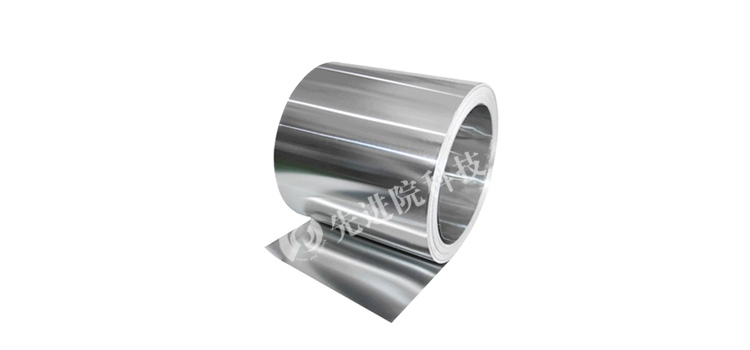
PI coated niobium titanium thin filmThe preparation of the material requires breaking through two major technical barriers: one is the bonding strength between PI film and NbTi layer, and the other is the interface stability under low temperature environment. Advanced Institute Technology adopts magnetron sputtering technology to uniformly deposit NbTi atoms on the surface of PI in a vacuum environment. By optimizing the sputtering power (500W) and substrate temperature (150 ℃), the interface bonding force reaches 15N/cm, far exceeding industry standards. In addition, by introducing a titanium transition layer between PI and NbTi layers, the difference in thermal expansion coefficient was effectively alleviated (PI is 3 × 10 ⁻⁵/K, NbTi is 8 × 10 ⁻⁶/K), ensuring that the material has no delamination risk in the range of -269 ℃ to 400 ℃.
2、 Application scenario: the "key springboard" from laboratory to industrialization
2.1 Superconducting Cable: The 'Efficiency Revolution' in Energy Transmission
Traditional copper cables generate significant Joule heat when transmitting high currents, while superconducting cables can achieve zero loss transmission. The application of PI coated niobium titanium film has solved two major problems in superconducting cables: firstly, the insulation performance of PI eliminates the need for additional insulation layers, simplifying the structure of the cable; Secondly, the superconducting properties of NbTi enable the cross-sectional area of the cable to be reduced to 1/10 of that of copper cables, resulting in an 80% weight reduction. Taking the thin film purchased by a certain enterprise in Xi'an as an example, the 10kV superconducting cable prototype used for research and development has a transmission capacity of 5000A under liquid nitrogen cooling, which is five times that of copper cables of the same voltage level.
2.2 Superconducting magnets: the "core engine" of medical and scientific research
In the medical field, the magnet of MRI equipment needs to operate stably under a strong magnetic field of 1.5T to 3T. The flexible properties of PI coated niobium titanium film enable the magnet to be wound into complex shapes and improve magnetic field uniformity. For example, Advanced Institute Technology customized a 20 micron PI coated niobium titanium film for a medical enterprise to develop a 7T superconducting MRI magnet. The magnetic field uniformity is better than 0.1ppm, significantly improving imaging resolution. In the field of scientific research, the focusing magnet in particle accelerators needs to withstand the impact of high-energy particle beams, and the radiation resistance of PI (with no attenuation at a dose of 10 ⁶ Gy) perfectly complements the superconducting stability of NbTi.
2.3 Extreme Environment Equipment: "Performance Guarantee" for Deep Sea and Space
Deep sea exploration equipment needs to withstand high pressure (about 110MPa) and low temperature (-2 ℃), while space probes need to cope with cosmic ray irradiation and extreme temperature differences. The compressive strength (up to 300MPa) and radiation resistance (stable performance at a dose of 10 ⁷ Gy) of PI coated niobium titanium film make it an ideal material for deep-sea cables and space superconducting energy storage devices. The thin film purchased by a certain enterprise in Xi'an is being used for the research and development of deep-sea superconducting communication cables. Its transmission loss is reduced by 90% compared to traditional copper cables, and it can work stably in a 5000 meter deep sea environment.
3、 Market pattern: the leap from "import dependence" to "domestic substitution"
3.1 Global Market: Technology Blockade under Oligopoly Monopoly
globalPI coated niobium titanium thin filmThe market has long been monopolized by companies such as DuPont in the United States and Zhongyuan Chemical in Japan, with their products occupying 80% of the high-end market share. And exports to China are restricted. This technological blockade has led to high research and development costs and extended project cycles for superconducting magnets in China.
3.2 China Breakthrough: From "Following" to "Running Together"
In recent years, domestic enterprises have achieved key technological breakthroughs through independent research and development. The performance indicators of PI coated niobium titanium thin film developed by Advanced Institute Technology have reached the international advanced level: NbTi layer thickness uniformity of ± 0.1 μ m, interface bonding force of 15N/cm, and superconducting critical current density (Jc) of 1 × 10 ⁴ A/cm ² at low temperatures. The procurement case of a certain enterprise in Xi'an marks the official entry of domestic materials into the superconducting magnet supply chain, which is expected to reduce research and development costs by 30% and shorten project cycles by 50%.
4、 Future outlook: Upgrading from "single material" to "ecological construction"
4.1 Technological Iteration: Breakthrough from "Two Dimensional" to "Three Dimensional"
Currently, PI coated niobium titanium thin films mainly have two-dimensional structures. In the future, complex shaped superconducting components such as shaped magnets and miniature superconducting coils can be prepared through 3D printing technology. For example, the laser selective melting (SLM) technology currently being developed by Advanced Institute Technology can directly deposit NbTi powder on a PI substrate, achieving integrated formation of three-dimensional superconducting structures.
4.2 Application Expansion: Fusion from "Superconducting" to "Multi Energy"
The potential of PI coated niobium titanium thin films is not limited to the superconducting field. Its high temperature resistance and insulation properties make it promising for applications in fields such as new energy batteries (such as solid-state battery electrolyte carriers) and flexible electronics (such as wearable device antennas). For example, a company in Xi'an is exploring the use of thin films for bipolar plates in hydrogen fuel cells, whose corrosion resistance and conductivity can significantly improve battery life.
4.3 Ecological Construction: Upgrading from "Material Supply" to "Solutions"
In the future, suppliers of PI coated niobium titanium thin films will transition to a "material service" model.Advanced Institute of TechnologyThe "Superconducting Material Customization Platform" has been launched, allowing users to select parameters such as film thickness, NbTi layer thickness, and interface treatment process online, and receive full process support from material design to application testing. This model will accelerate the popularization of superconducting technology and promote more industries to achieve "superconductivity" upgrading.
Conclusion: The "Golden Age" of Gold Composite Materials
The birth of PI coated niobium titanium thin film is a typical achievement of the "performance superposition" thinking in materials science. It not only solves the key material challenges in the field of superconductivity, but also provides new possibilities for industries such as energy, healthcare, and scientific research through customized services and technological iterations. The procurement case of a certain enterprise in Xi'an is just the starting point of this material industrialization journey. With technological breakthroughs and market expansion, PI coated niobium titanium thin films are expected to become the "basic materials" of the superconducting era, driving humanity towards a more efficient and cleaner future.
 en
en  Español
 Français
 Português