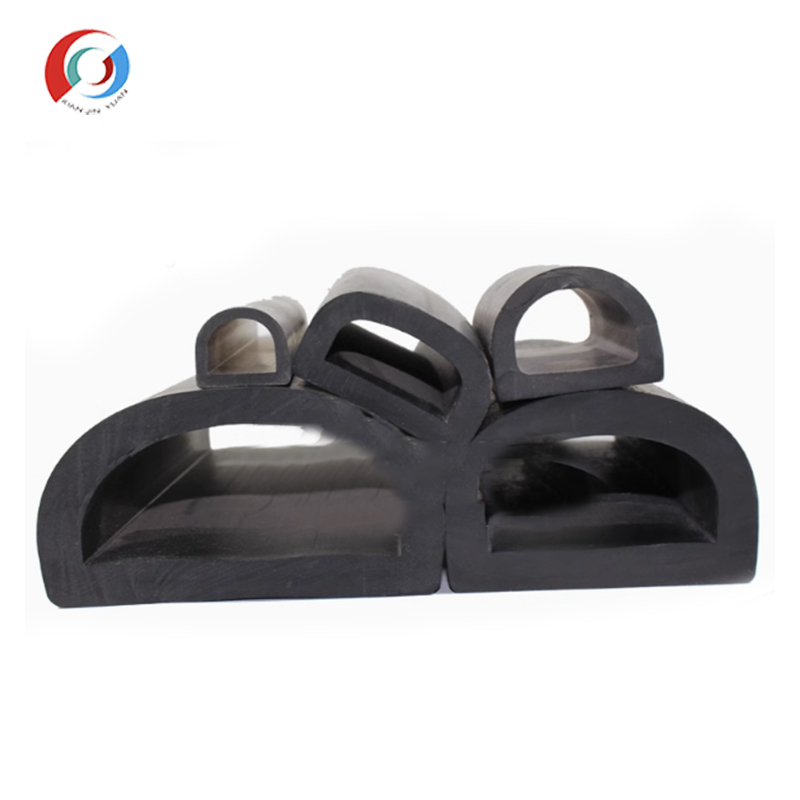
1、 Why is it "D-type" and why is it "hollow"?
The core function of conductive rubber strips is to form a continuous conductive path between two metal mating surfaces, while achieving environmental sealing. However, the demands for compression force, deformation space, weight, and cost vary in different application scenarios, which determines the differentiated value of cross-sectional design.
The design logic of the hollow D-type conductive rubber strip precisely responds to two of the most practical constraints in engineering practice: the adaptability of installation space and the economy of closing force.
The value of D-shaped cross-section lies in its fitting efficiency. Compared with circular or rectangular cross-sections, the flat bottom surface of D-type can form a larger effective contact area with the installation plane, providing more stable sealing pressure and lower contact resistance under the same compression amount. This is particularly critical for scenarios that require flat sealing, such as cabinet door frames and panel interfaces - the D-type design makes the conductive rubber strip less likely to roll or shift after installation, maintaining stable position during long-term use.
The value of hollow structures is more diverse. The internal cavity allows the rubber strip to absorb stress through deformation rather than volume transfer when under pressure, thereby achieving a larger compression stroke with a lower closing force. Research has shown that the recommended compression ratio for hollow extruded parts is 10% -50%, which is much higher than the 5% -10% for solid rubber strips. This means that engineers can achieve the same sealing and shielding effect with lighter locking structures and fewer fasteners. At the same time, the hollow design significantly reduces the weight per unit length and lowers material costs - in aerospace and portable devices, every gram of weight savings has engineering significance.
2、 The synergy between conductive network and elastic matrix
The performance of hollow D-type conductive rubber strips is rooted in their material composite system. It is based on silicone rubber and forms a three-dimensional conductive network by uniformly filling conductive particles such as silver plated aluminum powder, silver plated glass microspheres, nickel carbon composite materials, etc.
In this system, the silicone rubber matrix provides elastic recovery, weather resistance, and sealing durability, while the conductive filler is responsible for establishing a low resistance conductive path. The synergy of the two functions enables the conductive rubber strip to maintain stable electrical contact and effective barrier against water vapor and dust under compression.
The hollow D-type conductive rubber strip of Advanced Institute Technology can choose different conductive filler systems according to customer needs: the aluminum silver plating system is suitable for high-frequency communication scenarios and has excellent conductivity; The nickel carbon system has higher cost-effectiveness while maintaining good shielding effectiveness; The glass silver plating system exhibits outstanding corrosion resistance. Different fillers correspond to different volume resistivity and shielding effectiveness ranges, and customers can flexibly select based on the electromagnetic compatibility requirements, corrosion level, and cost budget of specific application environments.
At the manufacturing end, hollow D-type conductive rubber strips are usually produced using continuous extrusion molding technology, which ensures the appearance and dimensional accuracy of the product, as well as the continuity and stability of the conductive path. Advanced Institute Technology can customize cross-sectional dimensions and material formulas based on the installation slot size, compression requirements, and environmental conditions provided by customers, achieving one-stop delivery from design to mass production.
3、 From 5G base stations to new energy vehicles: application map of hollow D-type
Communication equipment: the cornerstone of cabinet level electromagnetic protection.
In 5G base stations and communication cabinets, the gap between the cabinet door and the cabinet body is the main electromagnetic leakage channel. Hollow D-type conductive rubber strips are widely used in cabinet door sealing grooves, which not only prevent external electromagnetic interference from entering the interior of the cabinet and affecting equipment operation, but also suppress internal electromagnetic radiation leakage to the external environment. Its lower closing force requirement makes frequent opening of cabinet doors more convenient to operate, and the elasticity of the hollow structure compensates for the small deformations that may occur during long-term use of the cabinet doors. With the extension of 6G communication research to higher frequency bands, the consistency of shielding effectiveness of conductive rubber strips in high frequency bands is becoming a new technological focus.
New energy vehicles: from battery management to vehicle grounding.
The electrical architecture of new energy vehicles poses a dual challenge to electromagnetic compatibility and sealing protection. The hollow D-type conductive rubber strip between the battery management system (BMS) and the vehicle body not only prevents moisture and dust from entering sensitive circuits, but also ensures a low impedance grounding path between the battery pack and the vehicle body. In the sealing of the electronic control unit (ECU) housing, the fitting advantage of the D-shaped section makes the installation more reliable. In addition, the conductive sealing strip at the connection between the car door and the body also serves the function of electrostatic discharge - the wear problem caused by frequent opening and closing of the car door is alleviated through material formula optimization and wear resistance improvement.
Aerospace: Every gram of weight is related to efficiency.
The complexity of electromagnetic environment in aircraft electronic equipment cabin and satellite cabin is much higher than that in ground equipment. The core advantage of hollow D-type conductive rubber strips in such scenarios is lightweight - the weight savings brought by the hollow structure accumulate into significant fuel efficiency improvements or payload increases at the machine level. Its working temperature range covers -65 ℃ to 160 ℃, meeting the stringent environmental requirements of aerospace. For the challenges of high vacuum and strong radiation in the space environment, advanced technology can enhance them through special coatings or material composite technologies.
4、 Selection points and design suggestions
When selecting hollow D-type conductive rubber strips, engineers need to focus on the following dimensions: compression force and deformation - the hollow structure allows for a compression of 10% -50%, and the design should determine a reasonable compression stroke based on the flange structure and locking method; Shielding effectiveness - there are differences in shielding effectiveness among different conductive filler systems, with carbon nickel system reaching 95dB at 2GHz and aluminum silver plating system reaching 120dB at 10GHz; environmental tolerance - needs to be evaluated for working temperature range, chemical corrosion risk, and UV exposure level; Installation method - whether adhesive fixation is required, whether on-site splicing is needed to form a frame.
Advanced Institute Technology provides full process technical support from cross-sectional design, material selection to sample trial production and batch delivery, helping customers incorporate conductive sealing solutions into system considerations in the early stages of electromagnetic compatibility design.
5、 Outlook
The global conductive rubber gasket market is steadily expanding at a compound annual growth rate of 4.4%. Driven by emerging demands such as 5G/6G communications, intelligent connected vehicles, and low orbit satellite Internet, elastomer materials with both conductive and sealing functions are moving from "supporting role" to "key enabling elements". Hollow D-type conductive rubber strips are expected to play an increasingly important role in this process due to their comprehensive advantages in structural efficiency, functional integration, and cost control.
Advanced Institute (Shenzhen) Technology Co., Ltd. will continue to deepen its expertise in the field of conductive elastomers, providing customers with higher performance and more reliable conductive sealing solutions through material innovation and process optimization.
 en
en  Español
 Français
 Português