1、 Why do we need 'composite extrusion'? ——The technological transition from two processes to integrated molding
The core function of conductive rubber strips is to form a continuous conductive path between two metal mating surfaces to achieve electromagnetic shielding and provide environmental sealing. However, traditional fully conductive rubber strips face a structural contradiction: in order to achieve conductivity, a large number of conductive particles (such as silver, nickel/graphite, silver/aluminum, etc.) must be filled in the rubber matrix. However, the increase of conductive fillers will significantly improve the material hardness and compression permanent deformation rate, weakening the sealing performance. In other words, the better the conductivity, the poorer the sealing performance.
The emergence of composite extrusion technology is precisely to break this contradiction. Its technical logic can be summarized in eight words: each performing its own duties, forming at once.
In the co extrusion process, conductive elastomers (filled with metal particles of silicone rubber) and non-conductive elastomers (pure silicone rubber or fluorosilicone rubber) are extruded and vulcanized simultaneously through the same extrusion mold, forming a strong chemical bond between the two parts. The conductive part is responsible for establishing a low resistance conductive path and EMI shielding, while the non-conductive part is responsible for providing excellent elastic recovery and environmental sealing. The two parts each perform their respective duties, yet they are seamlessly integrated.
The engineering value brought by this process is multidimensional. In terms of performance, the non-conductive part does not contain conductive fillers, maintaining the original low hardness, high elasticity, and excellent compression rebound characteristics of silicone rubber, making the composite extruded conductive rubber strip have better sealing ability and longer service life under the same shielding effectiveness. At the cost level, conductive fillers (especially silver based fillers) are the most expensive material component in conductive rubber strips. The composite extrusion design only uses conductive elastomers in the parts that require conductivity, which can significantly reduce the amount of precious metal fillers used. At the installation level, one material simultaneously completes both electromagnetic shielding and environmental sealing tasks, simplifying the assembly process and avoiding the problem of fitting tolerances between two independent sealing components.
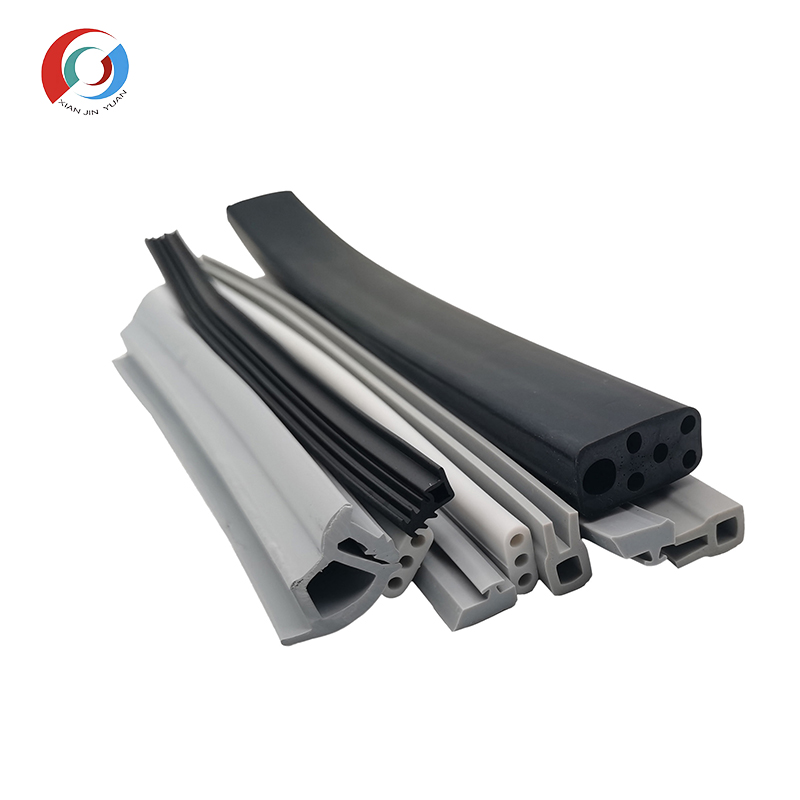
2、 From material selection to cross-sectional design: performance realization of composite extruded conductive rubber strips
The final performance of composite extruded conductive rubber strips depends on the synergy of three dimensions: material system, cross-sectional design, and interface bonding.
The material system determines the basic ability of conductivity and sealing. The silicone rubber matrix provides a wide temperature range of -55 ℃ to 170 ℃ and excellent weather resistance; The fluorosilicone rubber system can withstand chemical attacks such as fuel and solvents. The selection of conductive fillers directly affects shielding effectiveness and cost: the silver/aluminum system has the best conductivity, with a volume resistivity of up to 0.008 Ω· cm or less; The nickel/graphite system has higher cost-effectiveness while maintaining good shielding effectiveness. Advanced Institute Technology can flexibly select filler systems based on customers' requirements for shielding frequency bands, conductivity, and cost budgets.
The cross-sectional design determines the adaptability of materials in specific installation scenarios. The composite extrusion process supports flexible customization from simple rectangles, D-shapes to complex irregular cross-sections. The conductive parts can be set at the top, bottom, or sides, while the non-conductive parts fill the remaining areas - this "on-demand arrangement" design freedom allows engineers to accurately match different flange shapes, compression strokes, and shielding directions.
Interface bonding is the core technical barrier of composite extrusion technology. The conductive and non-conductive parts undergo synchronous vulcanization during the co extrusion process, forming a chemical bond rather than a physical adhesion between them. This means that the two parts will not separate or peel off during use - even after long-term thermal cycling and mechanical compression, the integrity of the interface will still be maintained.
3、 Three core application scenarios: from communication base stations to military equipment
5G/6G communication equipment is one of the fields with the highest demand for composite extruded conductive rubber strips. The 5G communication frequency band is higher, the base station density is higher, and the equipment integration is higher, which synchronously increases the requirements for electromagnetic compatibility and environmental sealing. The communication cabinet door frame, RF module interface, filter cavity and other parts require reliable EMI shielding to prevent signal leakage and external interference intrusion, as well as IP67 or even IP68 waterproof and dustproof sealing to ensure the reliability of long-term outdoor operation. Composite extruded conductive rubber strips exhibit irreplaceable advantages in such scenarios due to their integrated characteristics of "one material, two layers of protection". The conductive part provides shielding effectiveness of up to 90dB, while the non-conductive part ensures excellent waterproof and dustproof performance.
Aerospace and military electronics represent the application scenarios where composite extruded conductive rubber strips require the highest reliability. The complexity of electromagnetic environment in aviation electronic equipment cabin, radar system, missile guidance cabin and other parts is much higher than that of ground equipment, and they also need to withstand severe temperature changes, vibration impact and salt spray corrosion. Composite extruded conductive rubber strips have been widely used for electromagnetic interference resistance in military electronic equipment such as aviation, aerospace, and navigation. The non-conductive part adopts pure silicone rubber or fluorosilicone rubber matrix, which has excellent resistance to mold and salt spray corrosion. Many products can meet the MIL-DTL-83528 US military standard for conductive elastomer shielding gaskets, providing full chain support from materials to certification for military customers.
New energy vehicles and industrial control are the fastest-growing application directions. The electronic control unit (ECU), battery management system (BMS), on-board charger (OBC) and other components of new energy vehicles need to prevent electromagnetic interference from affecting sensitive circuits, as well as resist the invasion of water vapor and dust. Composite extruded conductive rubber strips are widely used in automotive sealing, connector gaskets, and other scenarios. In the fields of industrial control chassis, medical diagnostic equipment, etc., its ability to meet both EMI shielding and high waterproof requirements is also highly favored.
4、 Selection points and design suggestions
When selecting composite extruded conductive rubber strips, engineers need to focus on the following dimensions: the position and direction of the conductive part - the layout of the conductive layer needs to be determined based on the grounding path and shielding direction of the flange surface; Hardness and permanent compression deformation - non-conductive parts should provide sufficient elastic recovery to ensure stable sealing pressure during long-term use; Environmental tolerance - requires assessment of working temperature range, chemical corrosion risk, and waterproof and dustproof level requirements (IP level); Cross section customization - The composite extrusion process supports flexible cross section design, and it is recommended to communicate the customization plan with the supplier in the early stage of structural design.
Advanced Institute Technology provides full process technical support from cross-sectional design, material selection to sample trial production and batch delivery, helping customers incorporate composite extrusion conductive sealing solutions into their system considerations in the early stages of electromagnetic compatibility design.
5、 Outlook
The global co extruded EMI shielding gasket market is expected to grow to $437 million by 2032. At the same time, the global extruded EMI shielding gasket market is estimated to be worth $650 million by 2025 and is expected to exceed $1.06 billion by 2032. Driven by the continuous deployment of 5G/6G communication infrastructure, the deep evolution of automotive electrification and intelligence, and the accelerated upgrading of aerospace equipment, composite extruded conductive rubber strips with dual functions of EMI shielding and environmental sealing are moving from "professional material selection" to "standard configuration".
At the same time, the industry is evolving towards greater refinement. The nano modification of conductive fillers, continuous improvement of co extrusion accuracy, and optimization of shielding effectiveness for higher frequency bands (millimeter waves) are constantly expanding the performance boundaries of composite extruded conductive rubber strips. Advanced Institute (Shenzhen) Technology Co., Ltd. will continue to deepen its expertise in the field of conductive elastomers, providing customers with higher performance and more reliable composite extrusion conductive sealing solutions through material innovation and process optimization.

 en
en  Español
 Français
 Português