1、 What does 4.5 μ m mean?
A PET substrate with a thickness of 4.5 μ m is a "dangerous" presence on a roll to roll continuous coating production line - it can break under slightly high tension, shrink at slightly high temperatures, and wrinkle at slightly faster speeds. The PET gold plating film with conventional thickness (such as 25 μ m, 50 μ m) is quite mature, but compressing the substrate thickness to 4.5 μ m no longer challenges whether it can be plated or not, but whether it can still be used after plating.
Advanced technology has solved this problem. Through precise magnetron sputtering technology, a nano level precise deposition of gold layer was achieved on a 4.5 μ m ultra-thin PET substrate. The thickness of the gold layer can be continuously controlled within the range of 10nm to 2 μ m. The adhesion of the coating has reached level 5B through a hundred grid knife test - even after repeated bending and high-temperature welding, the gold layer will not bubble or peel off. There was no peeling or discoloration of the coating after 1000 hours of continuous exposure to 85 ℃/85% RH environment.
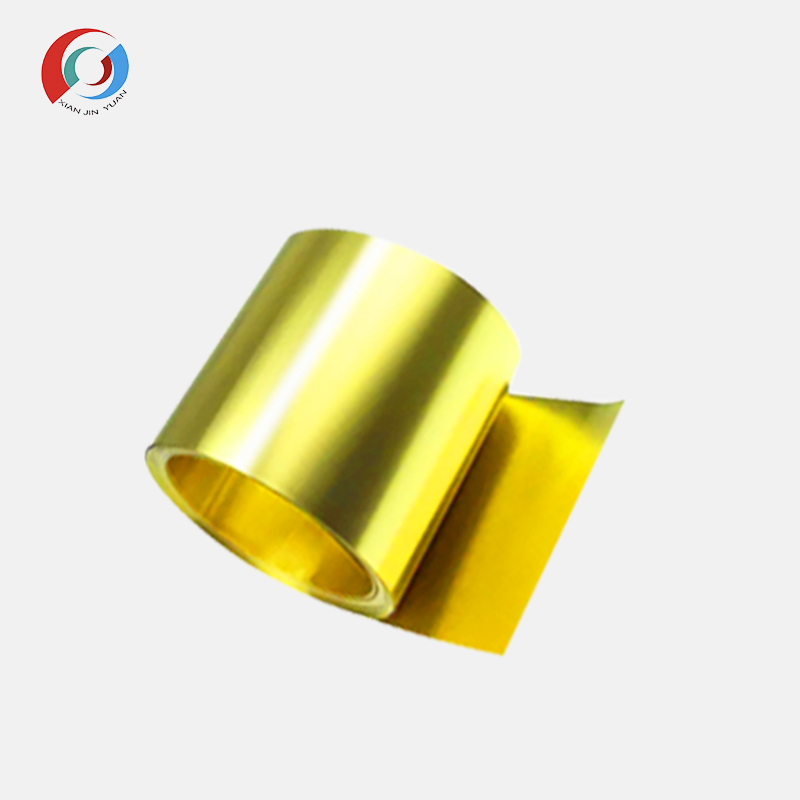
2、 Thin to the extreme, but with even stronger performance
The first advantage brought by a thickness of 4.5 μ m is the exponential improvement in bending performance. The thinner the substrate, the lower the bending stiffness - this means it can adapt to smaller bending radii and withstand higher frequency bending. After 100000 bending tests, the performance degradation is less than 3%. In scenarios such as foldable phones and wearable devices that require frequent bending, this data means that the lifespan of the material is almost equal to the lifespan of the device itself.
The second advantage is the liberation of weight and space. The 4.5 μ m PET gold plating film reduces weight by over 90% compared to the conventional 50 μ m thickness. In space payloads, every gram of weight savings means an increase in payload or fuel savings. A certain satellite payload project reduced the weight of the optical system by 27% by adopting an ultra-thin gold plating film scheme.
The third advantage is the maintenance of optical and conductive properties. The surface reflectivity of the gold layer is higher than 94% in the 400-700nm wavelength range, which is better than the industry average. The surface resistance can be as low as 0.1 Ω/□ or below. In the 10GHz frequency band, the shielding effectiveness can reach 52dB - thinner, but with no less functionality.
3、 The common choice between foldable screens and satellites: the three major battlefields of 4.5 μ m PET gold-plated film
Folding screens and flexible electronics are the most representative application scenarios for 4.5 μ m PET gold-plated film. A certain brand of foldable screen mobile phone uses PET gold plating film with a 0.3 μ m gold layer as the electromagnetic shielding layer in the hinge area, taking into account the reflectivity difference of less than 5% between 450nm blue light and 630nm red light, ensuring that the screen color uniformity Δ E value is less than 1.2. The ultra-thin substrate of 4.5 μ m completely opens up the design space of the hinge mechanism - thinner wiring, smoother bending, and longer lifespan.
Aerospace and optical payloads represent the highest dimensions of reliability requirements. The solar wing reflector of a certain spacecraft adopts advanced institute technology's gold plating film technology, achieving an infrared reflectivity of 96.3% in low Earth orbit environment, reducing heat load by 18% compared to traditional aluminum plating film. The thickness of 4.5 μ m allows every gram of weight to be spent on the blade.
Medical electronics and precision sensors are fields where 4.5 μ m PET gold-plated film is rapidly penetrating. The combination of gold's biocompatibility and the flexibility of ultra-thin PET makes it uniquely valuable in cutting-edge applications such as neural probes and biosensors. The gold-plated PET film serves as the target material substrate for particle accelerators, maintaining structural integrity under 200MeV proton beam bombardment and extending its service life by three times compared to traditional copper substrates.
4、 Customization: 4.5 μ m is just an option
4.5 μ m is a thickness option in the Advanced Institute Technology PET gold-plated film product matrix - designed for scenarios with extreme requirements for space and weight. The company supports customized film thickness and coating structure as needed to meet the differentiated needs of different application scenarios from consumer electronics to aerospace. Whether you need ultra-thin specifications of 4.5 μ m or universal specifications of 25 μ m and 50 μ m, Advanced Institute Technology can provide full process support from sample trial production to batch delivery.
The global flexible substrate market is expected to grow to $22.452 billion by 2032. Driven by the popularization of foldable screens, lightweight aerospace payloads, and flexible medical electronics, the 4.5 μ m PET gold-plated film is moving from "extreme manufacturing" to "standard options". When materials are so thin that they are almost invisible, their functionality remains unchanged - perhaps this is the most powerful answer to the proposition of "lightweight" in materials science.
 en
en  Español
 Français
 Português