1、 Why do mobile phones need "magnetic separators" - the triple contradiction from signal interference to lightweight body
Inside a modern smartphone, the number of RF devices, antennas, and communication frequency bands are constantly increasing. Bluetooth, Wi Fi, 5G sub-6GHz, NFC and other multi-mode communication coexist in the same small space. The problems caused by electromagnetic interference have three levels.
The most direct consequence is the damage to antenna performance. Antennas are extremely sensitive to the surrounding electromagnetic environment. Within a compact body, metal frames, batteries, camera modules, and other components can obstruct and interfere with antenna signals. In order to ensure signal quality, traditional designs often require a large "clearance zone" to be reserved for the antenna, which undoubtedly limits the flexibility of internal layout.
The decline in wireless charging and NFC experience is another pain point. The magnetic field emitted by the wireless charging coil spreads outwards in a divergent manner. When the "leakage flux" encounters the metal backplate, induced eddy currents will be generated inside the metal, resulting in energy waste and potential heat generation hazards. In NFC applications, metal objects absorb or interfere with magnetic flux lines, forming eddy currents, reducing the effective range, and even making communication impossible.
The contradiction between lightweight and electromagnetic shielding is a deeper design challenge. Although traditional metal shielding covers are effective, their thickness and weight have become bottlenecks in lightweight design.
Magnetic absorbing materials have found their place at the intersection of these three contradictions.

2、 Why do magnetic separators "absorb" waves? ——The paradigm shift from reflection to absorption
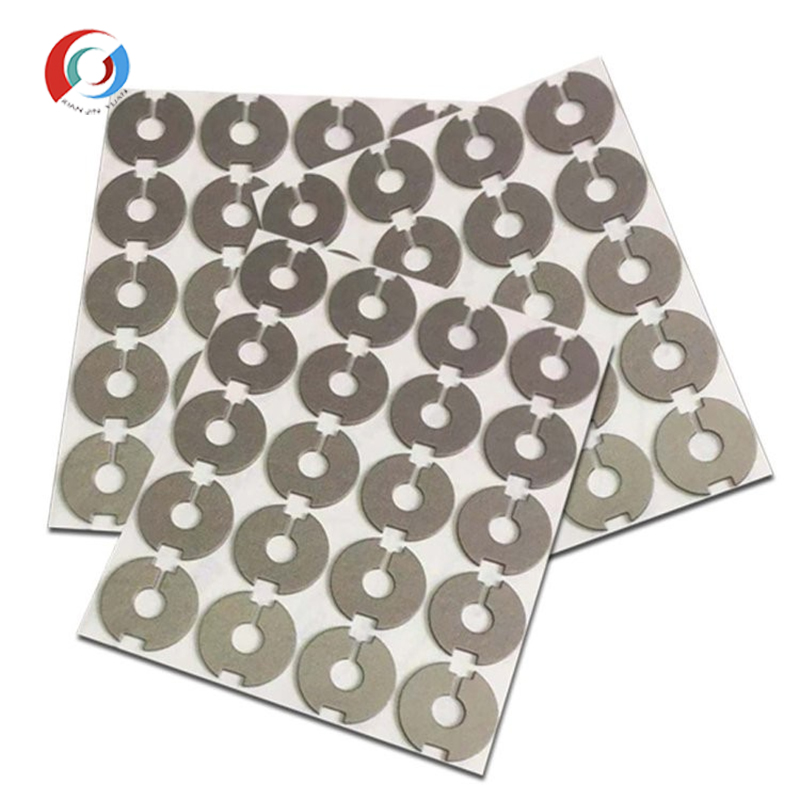
Magnetic separator is a flexible thin sheet made by mixing magnetic powder and resin. It converts electromagnetic wave energy into trace amounts of thermal energy and dissipates it through magnetic loss mechanism.
When electromagnetic waves enter the interior of the magnetic separator, the magnetic filler undergoes magnetization response in an alternating electromagnetic field - converting electromagnetic energy into thermal energy through mechanisms such as hysteresis loss, eddy current loss, and natural resonance. Unlike traditional shielding materials that "reflect" electromagnetic waves, magnetic separators "absorb" electromagnetic waves. The reflected wave did not disappear, it just changed direction and continued to bounce back inside the cavity; And absorption eliminates electromagnetic noise from the source.
In the NFC (13.56MHz) frequency band, the role of the magnetic separator is particularly critical. It limits the magnetic flux generated by the reader/writer within the magnetic screen, avoiding induced currents on the metal surface and maintaining optimal communication conditions. At a working frequency of 13.56MHz, the magnetic permeability range of high-performance absorbing wave plates can reach 120-250. At 1MHz, the initial magnetic permeability can reach over 110.
3、 Data Speaking: What problems can magnetic separators solve?
The performance of absorbing materials for mobile phone magnetic separators ultimately needs to be answered with data.
Thickness is the most intuitive advantage of magnetic separators. Traditional metal shielding covers require a certain amount of three-dimensional space, while the thickness of the magnetic isolation sheet can be as thin as a few millimeters or even thinner. Common thicknesses include 0.08mm, 0.1mm, 0.2mm, and 0.3mm. This "sticker instead of cover" approach directly eliminates the three-dimensional height of the metal cover, providing the possibility for battery expansion or achieving a thinner body structure.
The magnetic permeability determines the ability of the magnetic separator to guide magnetic field lines. At a working frequency of 13.56MHz, the magnetic permeability range of high-performance absorbing wave plates can reach 120-250. High magnetic permeability means that more magnetic flux can be guided at the same thickness, or the same magnetic permeability can be achieved at a thinner thickness.
The absorption efficiency determines how much electromagnetic noise the magnetic separator can 'consume'. Magnetic isolation sheet is a functional composite material that mainly absorbs electromagnetic waves, which can eliminate the back and forth reflection of electromagnetic waves in the shielding cavity and reduce the interference of clutter on its own equipment.
The application effect has been verified in real mobile phone design. Applying magnetic isolation sheets near the antenna can effectively isolate the interference of metal components on the back and stabilize the resonant frequency of the antenna. This means that the antenna performance is less affected by the internal structure, and designers can reduce the clearance area. Absorbing materials can efficiently absorb stray electromagnetic waves in specific frequency bands, and designers can accurately attach them between two components that are prone to mutual interference, forming a local electromagnetic isolation wall. This allows components that originally had to maintain a safe distance to be brought closer together, achieving a more compact and efficient stacking design.
4、 Three core application scenarios: from antennas to wireless charging
Antenna performance optimization is the most direct application of magnetic isolation sheets. Applying magnetic isolation sheets near the antenna can effectively isolate the interference of metal components on the back and stabilize the resonant frequency of the antenna. This reduces the influence of internal structure on antenna performance, allowing designers to reduce the clearance zone, layout the antenna in more ideal positions, and even adopt more compact antenna designs.
Wireless charging and NFC are the areas with the highest demand for magnetic separators. At the wireless charging receiving end of the mobile phone, a magnetic separator is attached between the coil and the metal back cover, which not only prevents eddy current heating, but also gathers magnetic flux to enhance induction strength. In NFC antenna applications, the magnetic separator restricts the magnetic flux generated by the reader/writer within the magnetic screen, avoiding induced currents on the metal surface. Amorphous magnetic separators can guide magnetic fields, reduce eddy current losses, and improve energy transfer efficiency.
Electromagnetic compatibility and signal integrity are the broader values of magnetic separators. Covering the motherboard with absorbing materials can absorb the noise generated by chips and circuits during operation, reduce electromagnetic coupling, and minimize signal interference. For 5G chips with continuously increasing operating frequencies, they must be used together with absorbing structures to compress EMI within specifications.
5、 Key selection points and market outlook
When engineers select electromagnetic absorbing materials for mobile phone isolation, it is recommended to start from the following dimensions:
The working frequency band is the first matching item. NFC (13.56MHz) requires materials with high magnetic permeability (μ '>100); Consumer electronics EMI (10MHz-6GHz) requires broadband absorption capability.
The thickness and installation space determine feasibility. The thickness of the magnetic separator varies from 0.08mm to 0.3mm. The interior of mobile phones is usually chosen to be ultra-thin.
The magnetic permeability and absorption efficiency need to be matched according to the specific frequency of the interference source. At 1MHz, the initial magnetic permeability can reach over 110.
The global RF absorbing wave plate market is estimated to be worth $386 million by 2025 and is expected to grow to $656 million by 2032. The global revenue scale of amorphous magnetic separators is about 1.468 billion yuan, and it will approach 2.448 billion yuan by 2032. The global market size of electromagnetic radiation suppression films is about 822 million US dollars, and it is expected to reach 1.287 billion US dollars by 2032.
Driven by the multiple factors of 5G/6G communication, high-frequency and lightweight consumer electronics, and the popularization of wireless charging, mobile phone magnetic isolation absorbing materials are moving from "professional selection" to standard configuration for electromagnetic compatibility design of smartphones.
Advanced Institute (Shenzhen) Technology Co., Ltd. will continue to deepen its cultivation in the field of mobile phone magnetic isolation absorbing materials, providing customers with higher performance and more reliable electromagnetic interference suppression solutions through material innovation and precision technology.
 en
en  Español
 Français
 Português