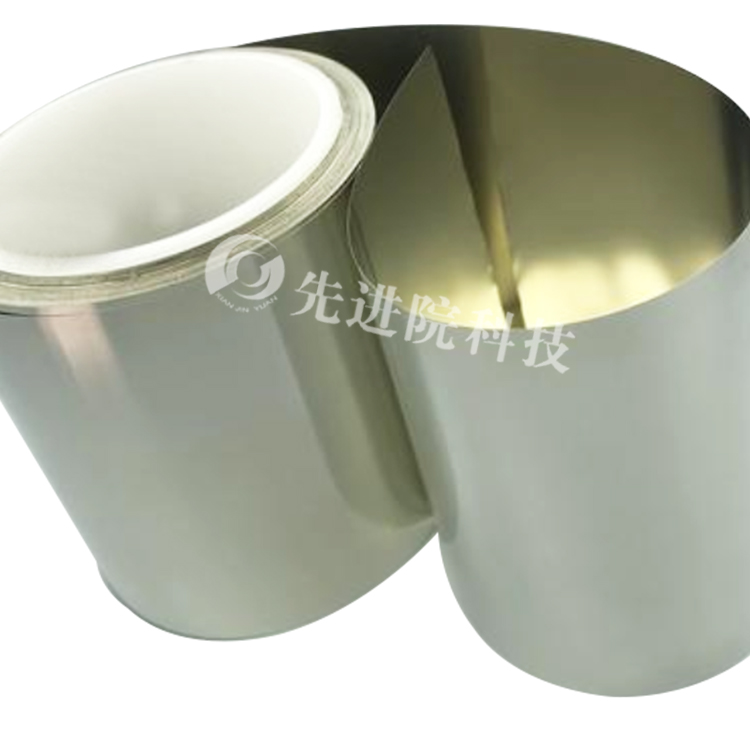
In the high-frequency signal transmission scenario of 5G communication base stations, when the transmission efficiency of traditional copper foil decreases by 15% due to signal attenuation, a leading communication equipment supplier successfully reduced the signal loss to below 3% by using rolled double-sided nickel plated copper foil. This case reveals a key fact: in the high-end manufacturing field, small improvements in material properties often lead to a qualitative leap in system level performance.Rolled double-sided nickel plated copper foilAs a new generation of functional metal composite materials, it is redefining the boundaries of the electronic industry's understanding of basic materials with its unique performance combination and process advantages.
1、 Perfect recombination of material genes: a dual breakthrough in conductivity and protection
Traditional copper foil materials face a fundamental contradiction: the excellent conductivity of copper (International Annealed Copper Standard IACS 100%) naturally contrasts with its susceptibility to oxidation and corrosion. In the field of new energy batteries, this contradiction is particularly prominent - test data from a power battery manufacturer shows that after being stored in an environment of 85 ℃/85% RH for 200 hours, the contact resistance of ordinary copper foil increases by 37%, while the resistance change rate of double-sided nickel plated copper foil is controlled within 5%.
The presence of nickel layer constructs a triple protection mechanism:
1. Electrochemical protection: The standard electrode potential of nickel (-0.25V) is higher than that of copper (-0.34V), forming sacrificial anode protection
2. Physical barrier: A 0.5-3 μ m nickel layer can block 99.9% of oxygen and water vapor penetration
3. Mechanical strengthening: The hardness of nickel (HV 200-250) is more than three times that of copper (HV 60-80), significantly improving wear resistance
This kind of protection is not simply a combination. Through precision controlled electroplating process, the nickel layer forms metallurgical bonding with the copper substrate, with an interface bonding strength of over 25MPa, far exceeding the industry standard of 15MPa. The application of a certain consumer electronics giant in folding screen hinge components has proven that this composite structure can withstand 200000 folding tests without cracking.
2、 Precision Control of Rolling Process: The Art of Microstructure
Under the scanning electron microscope of a national laboratory in Shenzhen, the rolled double-sided nickel plated copper foil produced by the Advanced Institute exhibits a unique layered crystal structure: the copper substrate shows a preferred orientation of (111) crystal planes, while the nickel layer forms a small columnar crystal structure. This microstructure is precisely controlled through multiple cold rolling and intermediate annealing processes, bringing three performance advantages:
1. Breakthrough in surface quality: By using a twelve roll reversible rolling mill and laser texturing technology, the surface roughness Ra value can be stably controlled below 0.08 μ m, which is 60% lower than traditional electrolytic copper foil. In high-frequency circuit applications, this ultra smooth surface reduces losses caused by skin effect by 22%.
2. Thickness accuracy revolution: Through online thickness gauges and closed-loop control systems, thickness tolerances are controlled within ± 0.3 μ m. A semiconductor packaging company has provided feedback that this precision has increased the bonding yield from 98.5% to 99.8%, saving over a million yuan in rework costs annually.
3. Residual stress optimization: The innovative three-stage annealing process reduces residual stress to below 15MPa, far below the industry average of 50MPa. In the application of new energy vehicle motor windings, this low stress characteristic increases the interfacial adhesion between copper foil and insulation material by 40%.
3、 Paradigm innovation of customized production: from standard products to solutions
On the production line of a new energy enterprise in Shenzhen, customized nickel plated copper foil with a thickness of only 4 μ m is being wound into battery cell ears. This case reveals a new requirement for materials in high-end manufacturing: no longer satisfied with standard specifications, but requiring deep involvement in product design.Advanced InstituteThe established 'Material Gene Bank' contains 2000 sets of process parameter combinations, which can achieve:
·Thickness gradient control: Achieving a gradual transition from 4 μ m to 12 μ m on a single roll of material to meet the conductivity requirements of different parts of the battery module
·Local performance enhancement: By using zone electroplating technology, the nickel layer thickness is increased to 5 μ m in specific areas to enhance the corrosion resistance of the welding area
·Functional coating integration: Composite graphene or titanium nitride coating on the surface of nickel layer to further reduce contact resistance by 15%
This customization capability is built on three major technological platforms:
1. Digital twin system: Real time simulation of the impact of 128 process parameters on material properties
2. Flexible production line: achieve product switching within 2 hours through a fast mold changing device
3. Failure Analysis Center: equipped with FIB, EBSD and other equipment, establish a performance process mapping model
4、 Cross border expansion of application scenarios: penetration from electronics to energy
In the AAU module of 5G base stations, rolled double-sided nickel plated copper foil simultaneously serves the triple functions of heat dissipation, conductivity, and electromagnetic shielding. Test data shows that after using this material, the operating temperature of the module decreased by 8 ℃, the signal transmission loss decreased by 1.2dB, and the system energy efficiency improved by 12%. This multi scenario adaptability stems from three major characteristics of the material:
1. Advantages of thermal management: With a thermal conductivity of 380W/and an ultra-thin structure, an efficient thermal channel is formed
2. Electromagnetic performance optimization: By adjusting the thickness of the nickel layer, the surface resistance can be controlled within the range of 50-200m Ω/□ to meet the shielding requirements of different frequency bands
3. Environmental adaptability: Within the temperature range of -40 ℃ to 150 ℃, the dimensional stability is better than ± 0.05%
In the field of new energy vehicles, tests conducted by a certain car company have shown that the motor controller using customized nickel plated copper foil can still function normally after 960 hours of salt spray testing, while traditional materials experience insulation failure after 480 hours. This durability improvement extends the warranty period of the entire vehicle from 5 years to 8 years.
5、 Opportunities for the reconstruction of industrial ecology: from material suppliers to technology partners
When an international semiconductor giant included Advanced Institute in its "preferred material supplier" list, it marked a shift in the industry cooperation model. This transformation is reflected on three levels:
1. Joint R&D mechanism: jointly build a "5G Materials Joint Laboratory" and share testing equipment worth 200 million yuan
2. Full lifecycle management: providing full support from material selection, process validation to failure analysis
3. Intellectual Property Sharing: Jointly apply for 12 international patents and build technological barriers
This deep cooperation brings significant economic benefits: a communication project has reduced the cost of a single base station by 1800 yuan through material optimization, resulting in an annual cost savings of 900 million yuan based on an annual production capacity of 500000 base stations. The more important strategic value lies in the fact that material companies have begun to participate in the formulation of industry standards and have control over the industry discourse.
Standing at the critical point of industrial upgrading,Rolled double-sided nickel plated copper foilThe value has surpassed the category of purely functional materials. It is both a "basic chip" for high-end manufacturing and a "catalytic carrier" for technological innovation. When material accuracy breaks through the micrometer level, performance regulation enters the atomic scale, and production modes achieve digital reconstruction, this industrial transformation triggered by basic materials is redefining the competitive boundary of Chinese manufacturing. For high-end equipment that pursues ultimate performance, choosing this material is not only a technical decision, but also a strategic investment for the future.

 en
en  Español
 Français
 Português