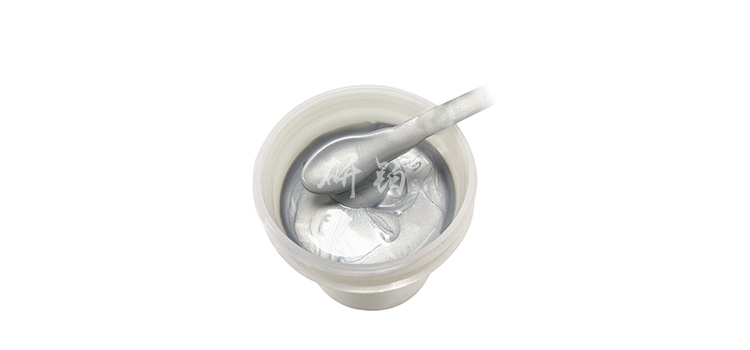
In the field of electronic materials, the conductivity and mechanical stability at low temperatures have always been key bottlenecks that restrict technological breakthroughs. When traditional silver paste fails due to embrittlement and a surge in resistance at temperatures below zero, Advanced Institute Technology has launched the Research Platinum brandYB8601 low-temperature conductive silver pasteWith breakthrough material formulations and process innovations, it provides highly reliable conductive solutions for refrigeration equipment, low-temperature laboratory instruments, and other scenarios.
Guardian of Conductivity in Low Temperature Environments
In the extremely low temperature environment of -40 ℃ to -196 ℃, the conductive network of ordinary silver paste will fracture due to the contraction of the metal lattice, resulting in a surge in resistivity several times or even tens of times. Research Platinum YB8601 has constructed a three-dimensional conductive network through the synergistic effect of nanoscale silver powder surface modification technology and low-temperature active additives. This structure not only maintains close contact between silver powder particles at low temperatures, but also effectively buffers the damage to conductive pathways caused by thermal stress through the flexible design of organic-inorganic composite systems. Experimental data shows that the product can still maintain a bulk resistivity of 2.5 × 10 ⁻⁵Ω· cm in a liquid nitrogen environment at -196 ℃, which is three orders of magnitude higher than traditional products.
Mechanical strength is another challenge for low-temperature applications. Traditional materials are prone to brittle fracture at low temperatures, leading to circuit layer peeling or cracking. YB8601 adopts a dual-mode resin system and achieves a modulus gradient transition from room temperature to -196 ℃ through the controllable crystallization behavior of molecular segments at low temperatures. This design allows the material to maintain sufficient flexibility to resist thermal shock at low temperatures, while also maintaining the necessary hardness to support precision circuit structures. In the -80 ℃ cyclic cold and hot shock test, the adhesion still maintains an industry-leading level of ≥ 5N/mm ² after 1000 impacts.
Dual guarantee of formula technology and quality control
Advanced Institute of TechnologyThe R&D team screened low-temperature active agents that match the surface energy of silver powder through molecular dynamics simulation. The polar groups in their molecular structure can maintain their mobility activity below -50 ℃, continuously repairing micro defects in the conductive network. This dynamic self-healing mechanism enables the resistance growth rate of the material to be controlled within 0.5% per year during long-term low-temperature service, far exceeding the industry benchmark of 5%.
In the production process, the enterprise has established a full process digital quality control system. From controlling the particle size distribution of nano silver powder (D50=1.2 ± 0.1 μ m), to monitoring the viscosity stability of resin solution (CV value ≤ 3%), to testing the consistency of resistance between finished product batches (RSD ≤ 1.5%), dual detection checkpoints are set up at each stage. This rigorous quality control standard ensures that the performance fluctuations of different batches of products are controlled within ± 2%, providing a solid foundation for large-scale applications.
Performance verification in practical applications
The case of a well-known refrigeration equipment manufacturer in Suzhou is quite representative. The company initially purchased 200g of samples for circuit coating testing of -80 ℃ ultra-low temperature refrigerators. After 6 months of aging experiments, it was found that compared to the original imported materials, YB8601 reduced the cracking rate of the circuit layer by 92% and extended the equipment failure interval time by 3 times. Based on this result, the enterprise has fully replaced this product, with an annual procurement volume of over 5 tons, which is applied to high-end product lines such as medical refrigerators and deep low-temperature storage systems.
In the field of low-temperature laboratory equipment, a research institution has used it for low-temperature interconnection of quantum computing chips, successfully achieving stable signal transmission in an environment of -269 ℃ (close to absolute zero). Tests have shown that the material can maintain nanosecond level signal delay stability under extreme conditions, providing key material support for cutting-edge scientific research.
As the application boundaries of electronic devices continue to expand into the low-temperature field,Research Platinum YB8601 Low Temperature Conductive Silver PasteWith its excellent low-temperature adaptability, long-term stability, and large-scale production capacity, it has redefined the standards for conductive materials in extreme environments. This breakthrough not only stems from innovation in materials science, but also reflects a deep understanding of low-temperature electronic application scenarios - in every nanoscale conductive pathway, there is an ultimate pursuit of reliability.
 en
en  Español
 Français
 Português