In rehabilitation assessment and motor function monitoring, surface electromyography (sEMG) is one of the most commonly used non-invasive detection tools - by using electrodes attached to the skin surface, weak electrical activity generated during skeletal muscle contraction can be recorded, providing objective data for the assessment of neuromuscular function.
However, therapists and engineers face a recurring dilemma: although the traditional Ag/AgCl wet electrode has low contact impedance and reliable signal quality, it relies on conductive gel. The gel will dry up over time, leading to signal deterioration, and long-term adhesion may cause skin irritation and even inflammation. The electrode cannot be reused and is prone to detachment during movement - in scenarios that require long-term continuous monitoring, the limitations of wet electrodes are particularly prominent.
�� Technical direction:Dry flexible electrodes are becoming a recognized technological direction in the industry. It does not need conductive gel, and can directly contact with the skin to collect signals. It has the core advantages of non irritation, long-term wear, and reuse. Flexible sEMG electrodes are becoming a powerful alternative and supplement to traditional Ag/AgCl electrodes.
2、 Engineering challenges for sEMG acquisition: impedance, noise, and motion artifacts
The essence of sEMG signal is the projection of muscle action potential on the skin surface - with amplitudes ranging from microvolts to millivolts, the signal is extremely weak. Collecting this weak signal from the surface of the skin poses a triple engineering challenge:
�� Electrode skin interface impedance
Low contact impedance is a prerequisite for ensuring high signal-to-noise ratio. Media such as the stratum corneum, sweat, and sebum can all affect interfacial impedance.
�� motion artifact
Mechanical noise is generated by the relative displacement between the electrode and the skin during dynamic motion, and rigid electrodes cannot conform to each other, which can lead to poor contact.
�� Power frequency interference
The high skin contact impedance does not match the input impedance of the amplifier, which can introduce 50/60Hz power frequency interference.
Core proposition:The core question that flexible non-invasive electrodes need to answer is - how to make the electrodes soft, stretchable, and wearable like skin while maintaining low impedance and high signal-to-noise ratio?
3、 Material system: diverse choices from metal to carbon based
The performance of flexible sEMG electrodes is rooted in the synergy between conductive materials and flexible substrates. The current mainstream material system covers three categories: metals, carbon based materials, and conductive polymers
�� Metal based
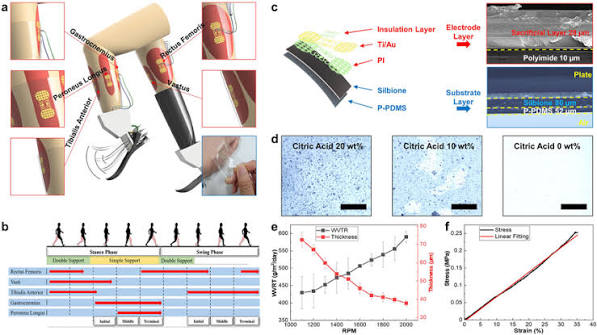
The impedance of the gold-plated electrode (50 μ m PI carrier, 2 μ m Au) is extremely low; The SNR of AgNW/graphene composite electrode reaches 11.5dB, which is comparable to Ag/AgCl.
�� carbon-based
MWCNT-PDMS dry electrode has an impedance of~490k Ω at 10Hz and an SNR of 34dB; the three-dimensional Ti ∝ C ₂ MXene/CNT electrode has an impedance 10 times lower than Ag/AgCl at 100Hz and a recognition rate of>90%.
�� conductive polymer
PEDOT: PSS inkjet printing multi-channel electrode; TPP composite material has a tensile strength of 200% and an adhesion force of 0.58N/cm.
4、 Structural Design: Mechanical Adaptation from Two to Three Dimensions
The stretchability of the material itself is limited. Structural design is equally crucial for maintaining stable contact between the electrode and the skin during dynamic motion.
�� Serpentine/3D Spiral
The extensibility after two-dimensional snake shaped packaging is 10-20%; After packaging with a three-dimensional spiral structure, the dynamic adaptability can still be improved by more than 131%.
�� High-density array
64 channel 3D MXene/CNT array and 12 channel gold-plated array (electrode diameter 1.2mm, spacing 3mm) were used to obtain muscle spatial distribution signals.
5、 Key Performance: What Engineers Should Pay Attention to
�� Contact Impedance
The impedance of the 3D MXene/CNT electrode at 100Hz is 10 times lower than that of Ag/AgCl; MWCNT-PDMS has a resistance of approximately 490k Ω at 10Hz.
�� Signal to Noise Ratio (SNR)
MWCNT-PDMS reaches 34dB; three-dimensional MXene/CNT is about 25dB; mixed graphene silver electrode is 11.5dB (equivalent to Ag/AgCl).
�� Stretching and flexibility
TPP electrode stretching rate~200%; The ductility of the three-dimensional spiral structure is greater than 131%; 50 μ m PI carrier with high flexibility.
⏳ long-term stability
MWCNT-PDMS maintains a reasonable SNR within two months, and the SNR slowly decays from 33dB to 26dB within 10 days.
6、 Application scenarios: From rehabilitation assessment to human-computer interaction
�� Rehabilitation assessment and exercise monitoring
High fidelity sEMG acquisition under high dynamic conditions, with a three-dimensional skin conformal electrode system maintaining stable signals during movement, used for neck activity and fatigue recognition.
�� Prosthetic control and human-computer interaction
Multi channel array collects gesture sEMG, combined with machine learning to achieve gesture recognition, and wearable armband integrates dry electrodes for real-time control.
�� Clinical diagnosis and continuous monitoring
SEMG is widely used in clinical diagnosis, rehabilitation monitoring, and muscle function assessment, and flexible non-invasive electrodes are evolving from niche medical applications to consumer and interactive technologies.
7、 From Materials to Systems: Advanced Institute Technology's Flexible Electrode Solution
Advanced Institute (Shenzhen) Technology Co., Ltd. (referred to as "Advanced Institute Technology") was established in 2016, headquartered in Bao'an District, Shenzhen. It is a national high-tech enterprise specializing in shielding materials, insulation materials, thermal conductivity materials, and precious metal coatings. The company has independently built a magnetron sputtering and vacuum evaporation production line, using roll to roll continuous production technology, which can achieve precise deposition of metal layers on various flexible film surfaces such as PI, PET, PEEK, LCP, etc. The substrate width can reach 350mm, and the ultimate vacuum degree can reach 1 × 10 ⁻⁴ Pa.
In response to the specific requirements of flexible non-invasive electrodes for surface electromyography acquisition, Advanced Institute Technology provides the following core capabilities:
�� Substrate selection
Various flexible films such as PI, PET, PEEK, LCP, etc., with thickness adjustable from a few micrometers to several hundred micrometers.
⚡ Coating scheme
High purity biocompatible metal coatings such as gold, platinum, silver, etc., with precise thickness control.
�� Process platform
Composite processes such as magnetron sputtering and vacuum evaporation support continuous roll to roll production.
✅ core competency
The adhesion of the coating is 5B grade (the highest grade of ASTM D3359), and the coating uniformity is excellent.
�� customized service
Support electrode patterning customization, electrode array layout can be designed according to customer needs.
8、 Conclusion
The essence of surface electromyography collection using flexible non-invasive electrodes is to establish a stable, low-noise, and biologically friendly signal channel between rigid electronic devices and soft biological tissues. It uses a flexible substrate to match the mechanical properties of the skin, a low impedance conductive layer to ensure signal quality, and structural design to "guide" motion strain from the functional layer - the three work together to answer a core engineering question: how to make electronic devices as soft as skin while also understanding muscle language.
From rehabilitation assessment to prosthetic control, from motion monitoring to human-computer interaction - flexible sEMG electrodes are bringing the collection of electromyographic signals from hospitals to homes, from static to dynamic, and from "sticking up" to "growing up". In this technological evolution, material selection, structural design, and precision coating processes have always been the core variables that determine the upper limit of electrode performance.
© 2026 Xianjin Yuan · Flexible sEMG Electrode Technical Reference
 en
en  Español
 Français
 Português